
Track Any Royal Caribbean Ship Live (Free)
Track any Royal Caribbean ship live and free with CruiseKick's in-browser tracker. See Icon of the Seas and the whole fleet — no app, no login.
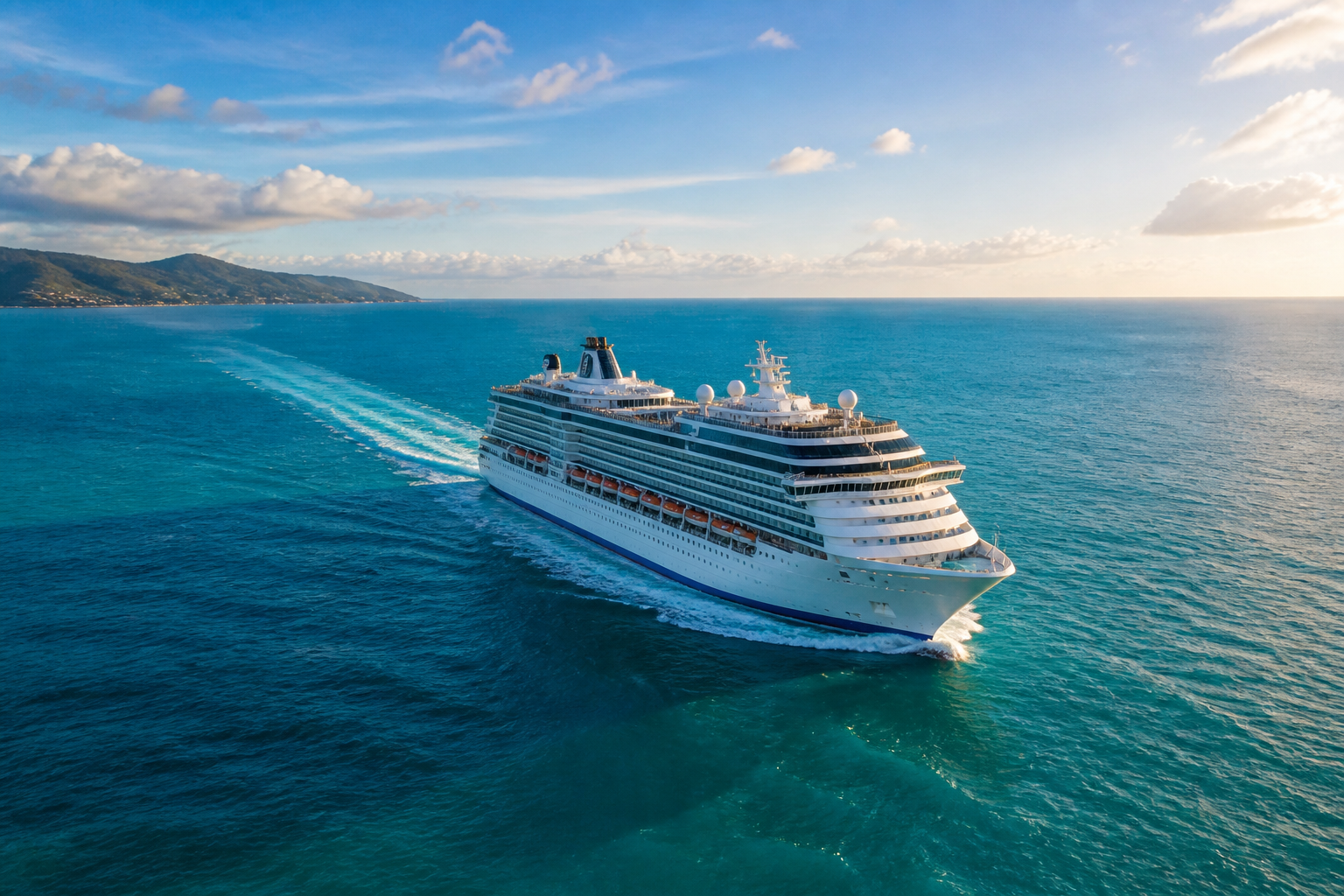
You can track any Royal Caribbean cruise ship live for free using CruiseKick’s in-browser cruise ship tracker — no app download, no account, and no subscription. Open the Royal Caribbean fleet tracker, pick your ship, and you’ll see its real-time position on a map along with its speed, heading, and next port. The positions come from AIS (the maritime radio signal every large passenger ship is required to broadcast), so they’re GPS-accurate on location but delayed by anywhere from a few seconds near shore to several minutes out in the open ocean.
If you’re here because you typed “where is Icon of the Seas now” into a search box, you’re in the right place — you can jump straight to the Icon of the Seas live location page and watch the world’s largest cruise ship move in real time.
Key takeaways
- Fastest path: Go to CruiseKick’s Royal Caribbean cruise ship tracker, find your ship, and click it for a live map. It works on any phone, tablet, or laptop browser.
- What powers it: Automatic Identification System (AIS) data — the same signal used for collision avoidance and coast guard monitoring worldwide.
- What you’ll see: Live position, speed in knots, compass heading, current or next port, and navigation status (underway, anchored, or moored).
- The honest caveats: Positions lag by seconds to minutes, mid-ocean coverage relies on slower satellite AIS, and a docked ship can appear “stuck” near a port because it isn’t moving.
The Fastest Way to Track a Royal Caribbean Ship
Here’s the short version before the detail: open CruiseKick’s live cruise ship tracker, narrow to the Royal Caribbean fleet, and select the ship you care about. That’s the whole process. When we tested this on a phone standing at a cruise terminal, the ship we were watching appeared on the map within a couple of seconds of the page loading — no login screen, no paywall, no “download our app to continue” wall.
A royal caribbean cruise ship tracker is useful in more situations than most people expect:
- Watching a family member sail. You dropped your parents at the pier, waved as the ship pulled away, and now you want to know where they are. A live tracker lets you follow their exact position from embarkation day through every port and the sea days in between.
- Pre-cruise anticipation. Sailing in a few days? There’s a real thrill in finding your ship on the map and watching it finish the voyage before yours.
- Port-day timing. Cruise schedules shift. A quick position check tells you whether your ship is still docked or already repositioning, which is the difference between a relaxed afternoon ashore and a sprint back to the gangway.
- Schedule verification. Weather diversions and itinerary changes happen. Tracking the ship’s actual position against its published itinerary gives you ground truth the cruise line’s own app sometimes lags behind.
For a line-agnostic walkthrough that applies to any cruise line, our companion guide on how to track a cruise ship covers the fundamentals. This article focuses specifically on the Royal Caribbean fleet.
How Cruise Ship Tracking Actually Works (AIS in Plain English)
Every Royal Caribbean ship — like all large commercial passenger vessels — continuously broadcasts an AIS (Automatic Identification System) signal. AIS is an international maritime standard: under IMO SOLAS rules, AIS is mandatory for all passenger ships regardless of size, and for cargo ships of 300 or more gross tons on international voyages. It was designed for collision avoidance and traffic monitoring, not for curious relatives at home, but the signal is public, and that’s what makes free tracking possible.
Each AIS broadcast packs in the ship’s:
- GPS latitude and longitude
- Speed over ground (in knots)
- Course and heading
- Navigation status (underway, at anchor, or moored)
- A unique MMSI identification number tied to that specific vessel
CruiseKick aggregates this AIS data, matches each MMSI to the correct Royal Caribbean ship, plots it on an interactive map, and serves it to your browser. There’s nothing to install and no account to create — you load the page and the ship is there.
Terrestrial vs. satellite AIS — and why it matters
AIS signals are picked up two ways, and the difference explains almost every quirk you’ll notice while tracking.
| Coverage type | How it’s received | Typical range | Update frequency |
|---|---|---|---|
| Terrestrial AIS | Shore-based antennas near coasts and ports | Roughly 20–40 nautical miles from shore | Very frequent — often every few seconds |
| Satellite AIS | Low-earth-orbit satellites | Global, including mid-ocean | Slower — minutes between updates, with gaps |
When a Royal Caribbean ship is cruising the Caribbean within range of coastal receivers, its position updates rapidly and looks nearly live. When it’s making a long open-ocean crossing — a transatlantic repositioning, for example — tracking depends on satellite AIS, so updates arrive less often and the ship’s icon may appear to “jump” as new data comes in. This is normal and affects every tracker, not just ours. We dig deeper into this in our explainer on how accurate cruise ship tracking is.
Step-by-Step: Track a Specific Royal Caribbean Ship
Step 1: Open the Royal Caribbean tracker page
Go to the Royal Caribbean Cruise Line tracker on CruiseKick. This page lists the active fleet with each ship’s live status — position, speed, current port if docked, and next destination. You can also start at the main cruise ship tracker hub and filter by cruise line to land in the same place.
Step 2: Find your ship
Royal Caribbean operates more than 25 ships, so the list is long. Ships are grouped and named so you can scan quickly. Look for your ship by name — whether it’s the flagship Icon of the Seas, an Oasis-class giant like Wonder of the Seas or Utopia of the Seas, or a smaller Vision- or Radiance-class vessel. Each listing shows a status at a glance: at sea, docked, or in transit.
Step 3: Open the ship’s live page
Click a ship name to open its individual tracking page. You’ll see:
- Live map position — an interactive map updating automatically as new AIS data arrives
- Current speed — in knots (multiply by roughly 1.15 for mph, though ships are always quoted in knots)
- Heading — the compass direction of travel
- Current port or coordinates — a named port if moored, or latitude/longitude if at sea
- Next destination — as reported in the ship’s AIS broadcast
- Navigation status — underway, at anchor, or moored
Step 4: Use the map
The map is interactive. Zoom in on the ship’s exact position, zoom out for route context, and pan around the region. Zoom out far enough over a busy corridor like the Florida Straits and you’ll often see other ships nearby, which gives a real sense of how crowded popular cruise waters actually are.
Step 5: Check back whenever you like
There’s no session limit or usage cap. Bookmark the ship’s page and return as often as you want. Position data refreshes as new AIS transmissions come in — every few minutes at sea via satellite, and more frequently when the ship is near a coast with terrestrial receivers.
Where Is Icon of the Seas Now?
If Icon of the Seas is the ship you’re chasing, open its dedicated Icon of the Seas live location page for a real-time map and status.
A little context helps you read what you see. Icon of the Seas is Royal Caribbean’s Icon-class flagship and the largest cruise ship in the world, at roughly 250,000 gross tons. She entered service in January 2024 and carries around 5,600 guests at double occupancy — more when every berth is filled. She’s based at PortMiami and typically runs seven-night Caribbean itineraries that include Royal Caribbean’s private destination, Perfect Day at CocoCay in The Bahamas.
Because of that seven-night pattern, if you check the tracker mid-week you’ll usually find Icon of the Seas somewhere in the Western or Eastern Caribbean, cruising at a typical service speed of around 22 knots between ports. On a Saturday she’s often docked in Miami during turnaround — which is a good moment to explain a common source of confusion.
Why a docked ship looks “stuck.” When Icon of the Seas (or any ship) is moored in port, it isn’t moving, so its AIS position stays pinned to the pier and its speed reads at or near zero knots. The tracker isn’t frozen or broken — the ship is genuinely stationary. The same is true at a tender port where the ship sits at anchor offshore. If your ship appears parked near a port for hours, that’s almost always exactly what’s happening.
The Royal Caribbean Fleet You Can Track
Tracking is available for the full active fleet across every class. Here’s how the ships are organized:
| Class | Notable ships | Character |
|---|---|---|
| Icon class | Icon of the Seas, Star of the Seas, Legend of the Seas | Newest and largest; LNG-powered |
| Oasis class | Oasis, Allure, Harmony, Symphony, Wonder, Utopia of the Seas | Neighborhood-style mega-ships |
| Quantum class | Quantum, Anthem, Ovation, Spectrum, Odyssey of the Seas | High-tech, all-weather features |
| Freedom class | Freedom, Liberty, Independence of the Seas | Large, family-oriented |
| Voyager class | Voyager, Explorer, Adventure, Navigator, Mariner of the Seas | Original mega-ship generation |
| Radiance class | Radiance, Brilliance, Serenade, Jewel of the Seas | Mid-size, glass-forward design |
| Vision class | Grandeur, Rhapsody, Enchantment, Vision of the Seas | Smaller, classic ships |
Regardless of whether your ship is a compact Vision-class vessel or the record-setting Icon of the Seas, the tracking data is available on CruiseKick. (Royal Caribbean periodically adds new ships and rotates older ones out, so treat the tracker’s live fleet list as the source of truth over any static roster.)
Honest Limitations Worth Knowing
A good tracker is honest about what it can’t do. Keep these in mind:
- Positions are delayed, not instantaneous. Expect a lag from a few seconds near shore to several minutes mid-ocean. A tracker is “live” in the sense that it shows recent real data, not a millisecond-perfect feed.
- Mid-ocean gaps happen. On long open-water crossings, satellite AIS updates less often, so the icon can sit still for a while and then jump. That’s a coverage limitation, not an error.
- Docked and anchored ships appear stationary. Zero speed at a pier or anchorage is expected behavior, as explained above.
- Occasionally a ship won’t appear at all. AIS receiver gaps, a ship broadcasting from a spot with no nearby coverage, or a temporary data hiccup can make a vessel drop off briefly. We wrote a full troubleshooting guide on why your cruise ship might not be showing on the tracker if that happens to you.
None of these are unique to Royal Caribbean or to CruiseKick — they’re inherent to how AIS-based tracking works everywhere.
Tracking Other Lines
Sailing a different line, or tracking two ships at once? The same approach works fleet-wide. If you have friends or family on a different cruise line, our step-by-step guide to tracking a Carnival cruise ship live mirrors this one, and the general how to track a cruise ship guide covers every line in one place.
Start Tracking Now
Watching a Royal Caribbean ship cross the Caribbean in real time takes about ten seconds to set up and costs nothing. Open CruiseKick’s tracker, select the Royal Caribbean fleet, and pick your ship — or jump straight to Icon of the Seas’ live location if the world’s largest cruise ship is the one you’re following. No app, no account, no fee. Just your ship, on the map, right now.