
Cruise Muster Drill: What to Expect on Embarkation Day
The cruise muster drill is a mandatory pre-sailing safety briefing. Here's what to expect on embarkation day, how the eMuster works, and how to check in fast.
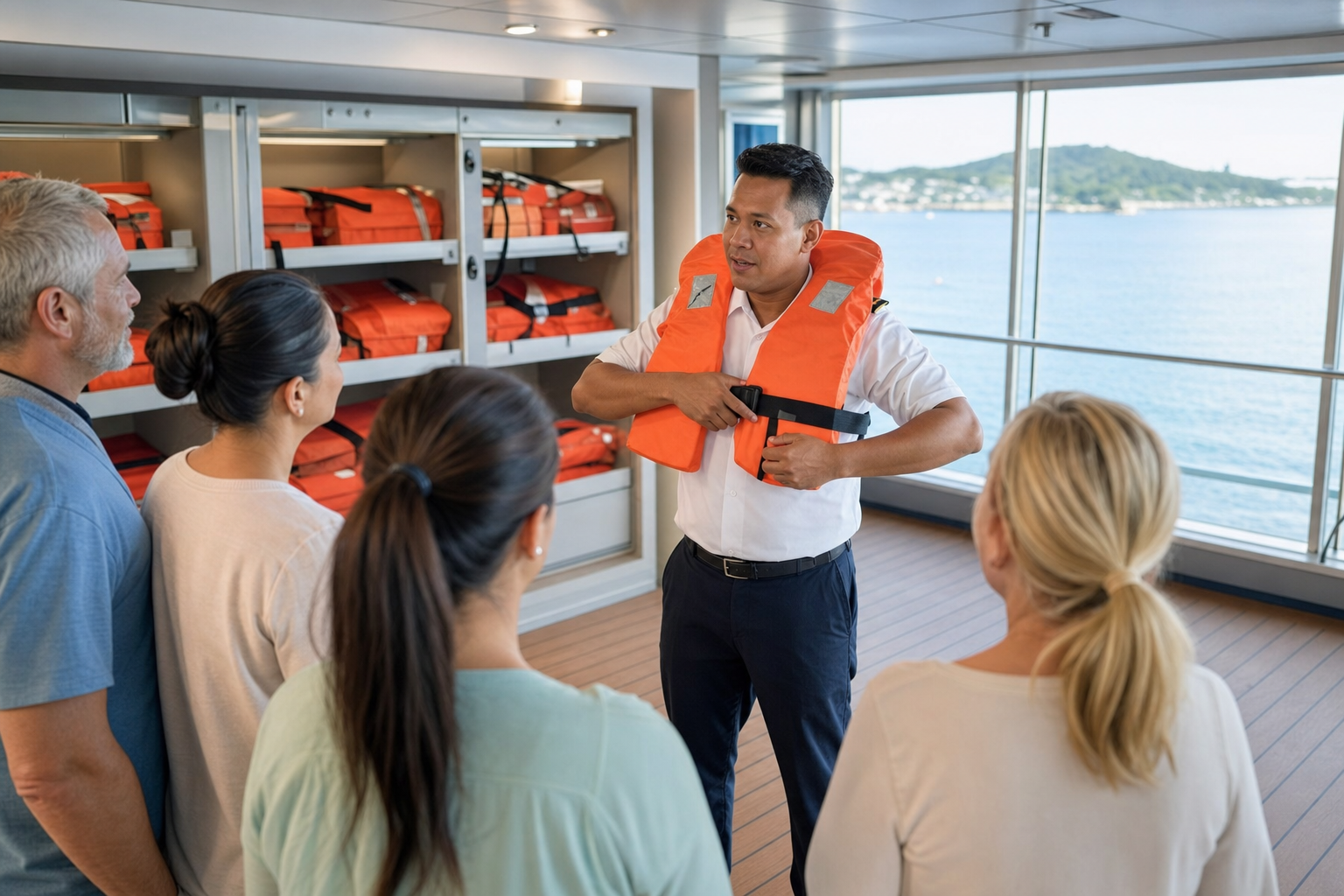
The cruise muster drill is a mandatory safety briefing every passenger must complete before the ship leaves port. On most major lines today it’s an “eMuster”: you watch a short safety video in the cruise line’s app or on your stateroom TV, then walk to your assigned muster station so a crew member can scan your card and confirm you’re accounted for. The whole thing takes just a few minutes, and the ship legally cannot sail until every guest has checked in.
If it’s your first sailing, the muster drill is one of the few genuinely non-negotiable tasks on embarkation day. It’s quick, it’s easy, and knowing exactly how it works means you can knock it out early and get on with your vacation. This guide walks you through the entire process step by step: what the drill is, why it’s required, how the modern eMuster differs from the old-school group version, how to find your station, and what happens if you skip it. For the bigger picture on settling into life aboard, see our Onboard Life guide.
What Is a Cruise Muster Drill?
A muster drill (also called the safety drill, emergency drill, or safety briefing) is a short exercise that teaches every passenger what to do if there’s an emergency at sea. “Muster” simply means “to assemble,” and your muster station is the specific location on the ship where you’d gather if the crew ever needed to organize passengers into lifeboat groups.
The drill covers the core safety information you’d need in a real emergency:
- Where your assigned muster station is and how to get there from your cabin
- How to recognize the general emergency signal
- How and when to put on a life jacket
- What the crew will instruct you to do if the ship is ever evacuated
Your muster station assignment is tied to the location of your cabin, so guests in different parts of the ship report to different stations. You don’t choose it, it’s assigned to you, and it’s printed right on your cruise card and shown in the cruise line’s app. If you’re just wondering whether ships even still bother with this, the short answer is yes — we cover that in do cruise ships still do muster drills.
Why the Muster Drill Is Legally Required
The muster drill isn’t a cruise-line preference, it’s international law. It’s mandated under SOLAS, the International Convention for the Safety of Life at Sea, which is the primary global treaty governing the safety of merchant and passenger ships. Under SOLAS, a muster of embarking passengers must take place before the ship departs or immediately upon departure, ensuring no guest sails without receiving essential safety information.
This “before departure” timing is the key point for planning your embarkation day. Older practice once allowed ships more leeway to hold the drill within the first 24 hours of sailing, but the modern standard is clear: you complete it before the ship leaves port, or right as it does. Because compliance is a legal condition of sailing, the ship physically cannot depart until every single passenger has been accounted for.
Every passenger completes the drill on every voyage, regardless of age, cabin class, or how many times they’ve cruised before. Prior experience doesn’t exempt you, and neither does a late arrival at the terminal.
eMuster vs. the Traditional Drill
If you cruised years ago, you may remember the traditional muster drill: an announcement would summon every passenger to open decks or public lounges at the same time, everyone would stand shoulder to shoulder holding life jackets, and the crew would run through the briefing to the whole crowd at once. It worked, but it was crowded, slow, and often the least pleasant part of embarkation day.
Most major cruise lines overhauled this after 2020, introducing an eMuster (electronic muster, sometimes branded with names like “Muster 2.0”) that breaks the same information into individual steps you complete at your own pace. Instead of gathering everyone simultaneously, the eMuster lets you absorb the safety briefing digitally, then check in at your station whenever it’s convenient during the boarding window.
Here’s how the two approaches compare:
| Feature | Traditional Drill | Modern eMuster |
|---|---|---|
| Safety briefing | Delivered live to a large crowd | Watched via app or stateroom TV |
| Timing | Everyone summoned at once | Complete individually, at your own pace |
| Crowds | Large gatherings on deck | Small groups or one-on-one at your station |
| Life-jacket demo | Group demonstration | Shown in video and/or by crew at station |
| Check-in | Attendance taken in the crowd | Crew scans your cruise card at the station |
| Typical time | 20-30+ minutes including waiting | A few minutes |
The eMuster covers exactly the same required safety content. The difference is delivery, not substance. A handful of smaller ships, luxury lines, or specific itineraries may still run a traditional in-person group drill, so always follow the instructions your particular ship gives you at boarding rather than assuming.
Step by Step: The Muster Drill on Embarkation Day
Here’s what the modern eMuster process typically looks like from the moment you board.
Step 1: Find Your Muster Station Assignment
Your muster station is assigned to you automatically and is easy to locate. Check for it in these places:
- Your cruise card (variously called the Sail & Sign card, SeaPass card, cruise card, or stateroom key), where the station is usually printed on the front or back
- The cruise line’s app, under your safety or check-in section
- Your boarding pass or stateroom documents
The station will be labeled with a letter, number, or code that corresponds to a specific location on the ship, often a lounge, theater, restaurant, or deck area. Note where it is relative to your cabin so you can find it quickly.
Step 2: Watch the Safety Video
Before you head to your station, complete the safety briefing digitally. Open the cruise line’s app or turn on your stateroom TV, where the safety video plays on a loop during embarkation. The video walks you through the essential information, including:
- How to put on your life jacket correctly
- The general emergency signal, which under international convention is seven or more short blasts followed by one long blast on the ship’s whistle and alarm system
- How to proceed calmly to your muster station if that signal ever sounds
- What the crew will direct you to do during an assembly
Watch it start to finish, since some apps track completion and won’t mark this step done if you skip ahead.
Step 3: Check In at Your Muster Station
Once you’ve watched the briefing, walk to your assigned muster station. A crew member will be there to:
- Confirm you’ve completed the video portion
- Scan your cruise card to log your attendance in the ship’s system
- Demonstrate or verify life-jacket donning if required on your ship
This in-person check-in is the part you cannot skip. Watching the video alone does not complete the drill, you must physically appear at your station to be counted. The good news: with the eMuster, this step often takes under a minute because there’s no crowd to wait through.
Step 4: You’re Done, Before Sail-Away
That’s it. Once you’ve been scanned in, your muster requirement is complete for the voyage. The ship tracks every guest’s check-in status in real time, and departure won’t happen until the count is complete. This is why doing it early matters, you don’t want to be the reason the manifest is still short at sail-away.
How the Muster Drill Varies by Cruise Line
At a high level, most major cruise lines now use the eMuster model, though the app names and small procedural details differ. In general terms:
- Royal Caribbean, Carnival, Norwegian, Princess, and Celebrity have moved to a self-paced electronic muster: watch the briefing digitally, then check in at your station.
- Disney Cruise Line is the notable exception — it returned to a traditional in-person assembly drill and still runs one, so expect to gather with other guests at your station.
- MSC and some other lines use a hybrid or fixed-time check-in that can still draw a crowd, so confirm your specific line’s current policy.
- App branding varies — on the eMuster lines you’ll find the safety briefing inside each line’s own app, and each line uses its own name for the cruise card.
- Some smaller, luxury, expedition, or specialty lines — and certain ships or itineraries — may also run a traditional in-person group drill.
Because the specifics evolve and vary by ship, the safest approach is to follow the instructions in your app and your stateroom on boarding day. Treat the general steps above as your framework and let your ship’s directions fill in the exact times and locations. New to all of this? Our first-time cruiser guide covers the full embarkation-day flow, from terminal check-in to finding your cabin, so the muster drill slots neatly into the rest of your day.
What Happens If You Skip or Miss the Muster Drill
Skipping the muster drill isn’t an option, and cruise lines take non-compliance seriously. Because the ship cannot legally sail until everyone is accounted for, the crew actively tracks who hasn’t checked in as departure approaches. If you haven’t completed yours, expect some combination of the following:
- Ship-wide announcements paging you by name or cabin number, asking you to report to your muster station
- Crew members following up directly, sometimes even coming to your cabin
- In serious cases of repeated refusal, guests can be removed from the sailing without a refund
None of this is meant to be punitive, it’s simply that international safety law leaves no discretion. One passenger holding out means the entire ship, and every other guest aboard, is delayed. Completing the drill promptly is the single easiest way to be a good shipmate on day one.
Practical Tips for a Painless Muster Drill
A few habits make the muster drill effortless:
- Do it as soon as you board. The eMuster is available almost immediately after you get on the ship. Handling it first means it’s off your list before you head to lunch or the pool.
- Bring your whole cabin. Everyone in your party must complete the drill individually, including children. Doing it together in one trip saves you from being paged later because a family member hasn’t checked in.
- Keep your cruise card handy. You’ll need it scanned at your station, and you’ll be carrying it everywhere on the ship anyway.
- Watch the full video. Don’t skip ahead, some apps won’t register completion if you do, which can leave you incomplete without realizing it.
- Know your station’s location. Glance at the deck plan once so you’re not wandering, especially on a large ship where your station may be several decks away.
- Follow your ship’s specific instructions. If your sailing uses a traditional group drill instead, listen for the announcement and go when called.
Handled early, the entire muster drill costs you just a few minutes of an otherwise exciting first day.
The Bottom Line on the Cruise Muster Drill
The cruise muster drill is a mandatory, legally required safety briefing you complete before your ship sails, and on most major lines it’s now a quick, self-paced eMuster: watch the video, walk to your assigned station, get your card scanned, and you’re done. It exists to make sure every person aboard knows where to go and what to do in the unlikely event of an emergency, which is exactly the kind of preparation you want happening before you relax into your vacation.
Do it the moment you board, bring everyone in your cabin, and it’ll be the easiest item on your embarkation-day checklist. For everything else about settling in once you’re aboard, dive into our Onboard Life guide.