
Cruise Ship Overboard Statistics: The Data
How often do people really go overboard on cruise ships? A data-first look at annual incident rates, survival odds, causes, and the industry response.
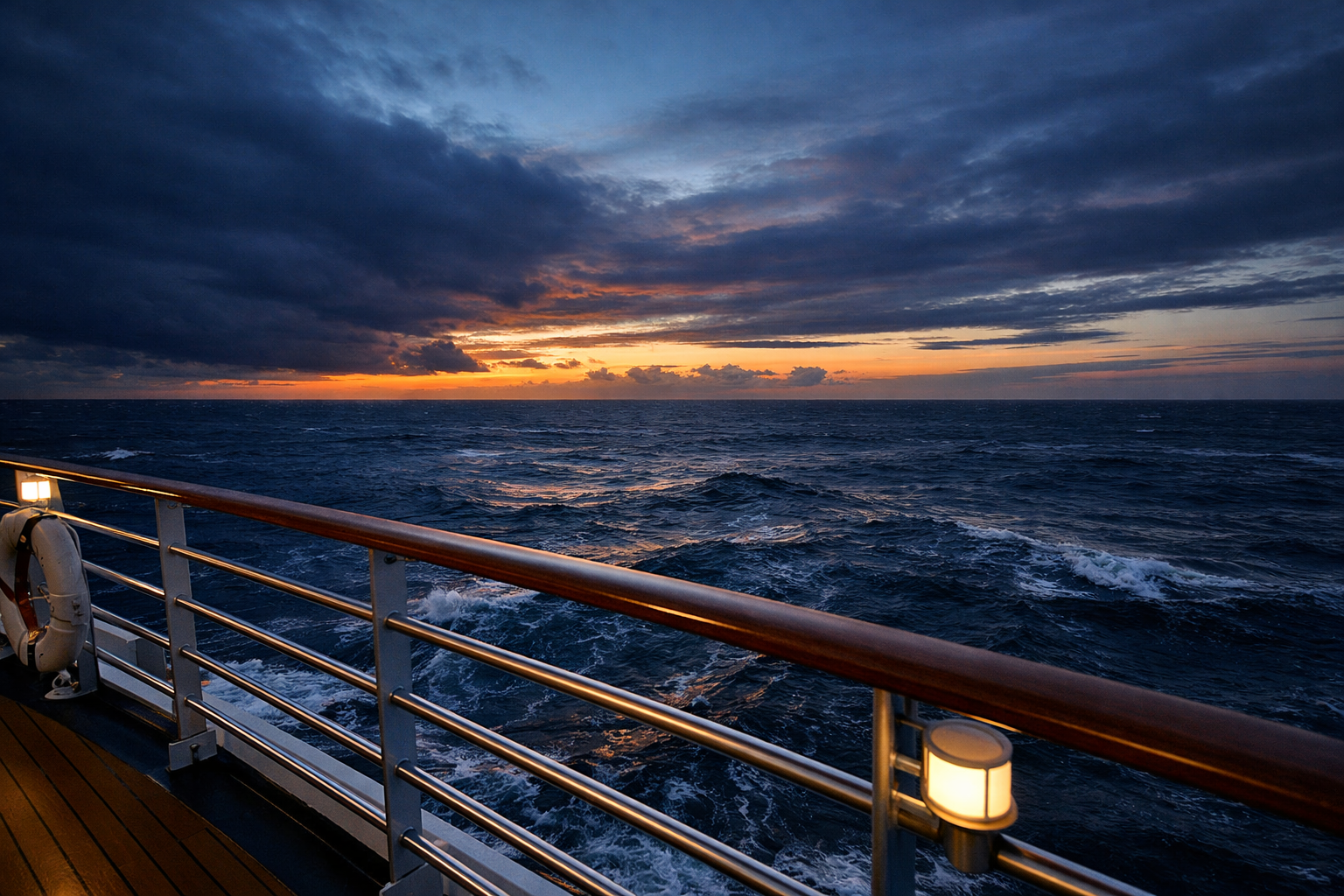
Every year, a small number of people go overboard from cruise ships. The internet tends to treat this fact in one of two ways: dismissive (“it almost never happens”) or alarmist (“the industry is hiding the truth”). Neither framing serves you well. What you actually want is the data — and that is exactly what this article delivers.
For broader context on cruise safety, including CDC inspection scores, illness outbreaks, and crime statistics, visit our Cruise Health & Safety pillar hub. And if you are asking the foundational question of how dangerous cruising actually is overall, our guide Are Cruise Ships Safe? is the right starting point.
This article focuses specifically on cruise ship overboard statistics: how many incidents happen per year, what causes them, how they have trended over time, and what the industry is doing about it.
The Headline Number: About 19–25 Overboard Incidents Per Year
The most reliable aggregate data on cruise ship overboard incidents comes from two primary sources: researcher Ross Klein’s CruiseJunkie.com, which has tracked incidents since 1995, and the U.S. Department of Transportation’s mandatory crime and incident reports required under the Cruise Vessel Security and Safety Act (CVSSA) of 2010.
Based on those sources, the industry average runs roughly 19 to 25 overboard incidents per year globally across all ocean-going cruise ships.
Looking at the decade from 2009 to 2019, researchers documented approximately 212 man-overboard incidents — an average of about 19 per year. The year 2024 saw exactly 19 documented incidents according to cruise industry tracking by Cruise Radio.
To put that in context: CLIA reported that the global cruise industry carried approximately 31.7 million passengers in 2023. Using the 2023 baseline of roughly 10 documented overboard incidents among that passenger count gives an implied rate of roughly 1 in 3 million passengers. Even using the higher annual averages in the 19–25 range against a 30-million passenger base, the rate stays well under 1 in 1 million passengers per year.
That does not mean the risk is zero or that these incidents do not matter. They matter enormously — to the individuals involved and their families. But you deserve to see the number in proportion.
Year-by-Year Trend
While comprehensive annual breakdowns are not always publicly released, the available data shows a rough picture:
| Period | Approximate Incidents | Notes |
|---|---|---|
| 1995–2008 | Variable, low baseline | Pre-CVSSA, limited mandatory reporting |
| 2009–2019 | ~212 total (~19/yr avg) | Most-studied decade |
| 2020–2021 | Sharply reduced | COVID-19 suspended most cruise operations |
| 2022 | Normalizing upward | Return to service, passenger volumes rebuilding |
| 2023 | ~10–19 reported | CLIA: ~31.7M passengers carried |
| 2024 | 19 documented | Per Cruise Radio industry report |
The COVID years (2020–2021) serve as an inadvertent controlled experiment: when ships stopped sailing, overboard incidents effectively disappeared. This confirms that the numbers are genuinely tied to operations and passenger volume rather than reporting artifacts.
It is also worth noting that reporting improved significantly after 2010. The CVSSA requires U.S.-embarking cruise lines to report missing persons and deaths to the DOT. Better reporting means some of the apparent increase from pre-2010 numbers reflects improved disclosure, not necessarily more incidents.
Causes: Accident, Suicide, and Unknown
One of the most important things to understand about cruise ship overboard statistics is that “fell overboard” covers several very different situations. The data, where available, breaks into roughly three categories.
Accidental Falls
Accidental falls — whether from balconies, open decks, or pool areas — account for a significant share of incidents. Alcohol intoxication is cited as a contributing factor in an estimated 60–80% of accidental overboard cases. Balcony falls specifically account for roughly 40% of passenger overboard incidents. Horseplay, attempting to jump between decks or into the water as a stunt, contributes to another portion.
The demographic most represented in accidental overboards skews toward middle-aged adults (40–59), consistent with the core cruise demographic. There is no strong evidence that children or elderly passengers are disproportionately represented.
Suspected Suicides and Intentional Incidents
Of cruise ship overboard deaths studied over the 2009–2018 period, approximately 19% were attributed to suicide, suspected suicide, or undetermined intentional acts. This is a genuine and underacknowledged aspect of the data — cruise ships, like other vacation environments, sometimes attract people in serious mental health crises. A small fraction of cases (under 2%) have involved suspected foul play or homicide.
Unknown or Unresolved
A meaningful share of cases — sometimes the majority in a given year — remain classified as unknown or unresolved. Someone is reported missing; CCTV footage is reviewed; there may or may not be evidence of an overboard event. The vessel and coastguard search. In some cases, no definitive determination is ever made. This is not a cover-up — it reflects the genuine difficulty of surveillance across a vessel with thousands of passengers and miles of ocean.
Survival Rates: Stark but Context-Dependent
Of the approximately 212 documented incidents from 2009 to 2018, roughly 48 individuals were rescued alive — a survival rate of approximately 22–28% depending on the study timeframe and methodology.
More recent data suggests modest improvement: a 2023 analysis of 28 major cruise overboard incidents found a recovery rate of approximately 42%, up 15 percentage points from the prior year. This improvement likely reflects faster detection enabled by newer technology (covered below) and more rapid response protocols.
Survival outcomes depend heavily on several variables:
- Time to detection: The faster a person is noticed missing, the faster the search begins.
- Water temperature: Cold-water incidents are far more lethal than tropical-water incidents.
- Whether the person was conscious: Intoxication or medical episodes reduce a person’s ability to stay afloat.
- Distance from ship at detection: A ship may be miles away before the overboard event is even discovered.
The U.S. Coast Guard is typically contacted once an overboard event is confirmed. Response times and resources vary significantly by geography — incidents in remote stretches of ocean have very different outcomes than those close to a port.
Which Cruise Lines See the Most Incidents?
The DOT’s CVSSA incident reports are published periodically and include missing persons data by cruise line. However, raw counts are almost meaningless without normalization against passenger volume. Carnival Cruise Line, which carried approximately 5.5 million guests in 2023 and operates the largest fleet by ship count in North America, consistently appears near the top of raw-count reporting. Royal Caribbean carried approximately 6 million guests that same year and also features prominently.
Neither figure means those lines are objectively more dangerous per passenger — it means they carry more passengers and thus face more statistical exposure. When researchers attempt to calculate incident rates per million passengers sailed, the differences between major lines narrow considerably. No major cruise line — including Carnival, Royal Caribbean, Norwegian, MSC, or Celebrity — has been shown to have a dramatically aberrant safety record specifically on overboard incidents when normalized for scale.
What Cruise Lines Are Doing to Prevent Overboard Incidents
The cruise industry’s prevention efforts operate on three levels: physical design, surveillance, and detection technology.
Physical Safeguards
The CVSSA of 2010 mandated minimum railing heights of 42 inches on all cruise vessels embarking in the U.S. This height makes it physically difficult — though not impossible — for an adult to fall accidentally over a railing without climbing on it first. Most modern cruise ships exceed this minimum. Balcony railings on newer vessels from lines like Royal Caribbean and Norwegian are typically solid rather than open rail design, reducing the visual temptation to lean or climb.
CCTV Surveillance
All major cruise ships are now required to maintain video surveillance systems under the CVSSA. Cameras are positioned along ship exteriors, deck perimeters, and in common areas. However — and this is a significant limitation — these cameras are almost never actively monitored in real time. Their primary use is forensic: when a person is reported missing, crew review hours of footage across dozens of camera feeds to try to identify the moment and location of an overboard event. The lag between an incident and its detection on CCTV is a genuine gap in the current system.
Automated Man-Overboard Detection Systems
This is where the most significant technological progress is happening. Systems like MOBtronic and ZOE use combinations of thermal cameras, infrared imaging, micro-radars, and AI-driven video analytics to detect a body entering the water in near-real-time, automatically alerting the crew and logging key data (speed, direction, time) to guide a rescue response.
In April 2025, Ambassador Cruise Line announced installation of an automatic man-overboard system — part of a broader industry trend. Notably, the International Maritime Organization has set a deadline of 2029 for mandatory installation of man-overboard detection systems on cruise ships. Until that deadline, installation remains voluntary and adoption is uneven across the fleet.
The gap between what is technologically possible and what is currently deployed is one of the more significant ongoing criticisms of the industry’s safety posture.
The Reporting Gap: What We Do Not Know
It would be misleading to present the data above without acknowledging its limits.
The CVSSA only applies to ships embarking or disembarking in U.S. ports. International sailings — including the vast majority of European, Asian, and Australian itineraries — operate under the International Maritime Organization’s SOLAS framework, which has different and generally less prescriptive public reporting requirements.
CruiseJunkie.com is the most comprehensive aggregator of global overboard data, but it relies heavily on news reports, legal filings, and voluntary disclosures. Incidents that never make the news — particularly those resolved quickly or occurring on ships without U.S. nexus — may never appear in the public record.
The practical implication: the ~19–25 per year figure is best understood as a floor, not a ceiling. The true global number may be higher. Whether meaningfully higher is genuinely unknown.
FAQ: Cruise Ship Overboard Statistics
How often do people fall off cruise ships? Based on available data, approximately 19 to 25 overboard incidents are documented globally per year. Against a global cruise passenger base of roughly 30+ million annually, this represents a rate of fewer than 1 incident per 1 million passengers.
What is the survival rate for going overboard on a cruise ship? Across the best-studied decade (2009–2018), roughly 22–28% of overboard individuals were rescued alive. More recent data from 2023 suggests the rate may be improving toward 40%+ as detection technology advances.
What causes most cruise ship overboard incidents? Accidental falls — frequently involving alcohol — are the most common cause. Balcony incidents account for a large share of the accidental category. Suspected suicides make up roughly 15–20% of cases. A portion of incidents remain unresolved.
Are cruise ships required to have man-overboard detection systems? Not yet universally. The IMO has mandated installation by 2029. Some lines are deploying systems voluntarily ahead of that deadline, but the majority of the current global fleet relies on passive CCTV surveillance rather than active detection.
Do cruise ships stop if someone goes overboard? Yes — once an overboard event is confirmed, standard maritime protocol is to immediately reduce speed, turn the ship back toward the last-known position, deploy rescue boats, and contact the Coast Guard. The challenge is the detection gap: ships may travel miles before an incident is discovered.
Which cruise line has the most overboard incidents? Carnival Cruise Line and Royal Caribbean appear most frequently in raw incident counts, but both carry the highest passenger volumes globally. When normalized per million passengers, no major line shows a dramatically elevated rate compared to the others.
Is cruising getting safer in terms of overboard incidents? The trend data is cautiously optimistic. Improved railing standards, wider CCTV coverage, and early adoption of automated detection systems have contributed to modestly better rescue rates. The 2029 IMO deadline for mandatory detection systems, if enforced, should produce a meaningful step change.
The Bottom Line
The cruise ship overboard statistics, viewed honestly, tell a nuanced story. These incidents are rare in absolute terms — far rarer than many people assume. They are also not as rare as the industry might prefer to emphasize. About 19–25 people go overboard from cruise ships each year globally, the majority do not survive, and a meaningful share of cases involve alcohol, mental health crises, or circumstances that remain unresolved.
The technology to detect these incidents in real time already exists. The industry’s regulatory framework, with its 2029 deadline for mandatory detection systems, is catching up — but there is a gap between what is possible today and what is deployed today.
For a complete picture of what the numbers say about cruise safety across all dimensions — from onboard illness to crime to structural incidents — explore our Cruise Health & Safety hub. And if you are weighing whether to cruise at all from a safety perspective, Are Cruise Ships Safe? walks through the full risk landscape with the same data-first approach.
Data sources used in this article include CruiseJunkie.com, the U.S. Department of Transportation CVSSA incident reports, Cruise Lines International Association (CLIA) passenger volume reports, Cruise Radio’s 2024 industry overboard report, and peer-reviewed analyses of maritime safety data. Where specific percentages are drawn from aggregated sources, ranges are provided to reflect variability across studies and timeframes.
Related guides
Part of our Cruise Health & Safety hub.