
Which Cruise Lines Have the Most Norovirus Outbreaks? (CDC Data Ranked)
Which cruise lines have the most norovirus outbreaks? CDC Vessel Sanitation Program data ranked by line — with the key context you need before booking.
Which Cruise Lines Have the Most Norovirus Outbreaks? (CDC Data Ranked)
- Royal Caribbean International and Carnival Cruise Line appear most often in CDC Vessel Sanitation Program (VSP) outbreak records — but this is a fleet-size effect, not a hygiene verdict: they carry more passengers on more sailings than any other lines.
- A cruise line with more CDC-investigated outbreaks is not necessarily “dirtier.” Lines that report transparently can look worse in raw counts than lines that under-report or carry fewer passengers.
- The CDC VSP investigates a gastrointestinal outbreak when 3% or more of passengers or crew report symptoms — making cruise ships among the most rigorously disease-tracked environments in all of travel.
- For the current, live list of investigated outbreaks by ship, consult the CDC VSP Gastrointestinal Illness Outbreak List directly.
When people search “cruise ship norovirus outbreak,” they usually want one of two things: reassurance that their upcoming sailing is safe, or a straight answer about which cruise lines show up most often in official disease records. This guide delivers the second — and explains why the answer requires more than a simple count.
We reviewed patterns in the CDC Vessel Sanitation Program outbreak database, the authoritative public record for gastrointestinal illness investigations on cruise ships calling at U.S. ports. Before we get to the line-by-line breakdown, you need to understand what the data is actually measuring, because a raw count ranking stripped of context will send you to entirely the wrong conclusion.
For a broader perspective on cruise health risks and safety statistics, our Cruise Health & Safety guide covers everything from sanitation inspection scores to onboard medical facilities.
What Counts as a CDC-Investigated Cruise Ship Norovirus Outbreak?
The CDC’s Vessel Sanitation Program has monitored cruise ships calling at U.S. ports since 1975. Any vessel carrying 13 or more passengers to a domestic port falls under VSP oversight, which includes unannounced sanitation inspections and mandatory illness surveillance throughout every voyage.
The investigation threshold: A formal CDC VSP investigation is triggered when 3% or more of passengers or crew report gastrointestinal illness during a single sailing. Symptoms include vomiting, diarrhea, or both. On a ship carrying 3,000 passengers, that means 90 reported cases crosses the line. Smaller illness clusters are tracked internally by the ship’s medical staff but may not appear on the VSP public database.
Not every outbreak is confirmed norovirus. The CDC VSP investigates all gastrointestinal illness outbreaks regardless of cause. When laboratory testing is completed, norovirus — usually the GII genotype — is confirmed as the pathogen in the majority of investigated cases. But Salmonella, E. coli, and other gastrointestinal pathogens do appear in the records, and some investigations list no confirmed etiology.
The transparency point that gets missed: Unlike hotels, restaurants, or theme parks, cruise ships are federally required to report gastrointestinal illness to the CDC whenever a threshold is crossed. A hotel can have 40 guests sick with norovirus over a weekend and never appear in any public database. A cruise ship with those same 40 sick guests will likely trigger a CDC VSP investigation if its total passenger count is under 1,400. Cruise ships are not uniquely prone to norovirus; they are uniquely required to document it. That documentation is a feature, not an indictment.
Cruise Lines Ranked by CDC VSP Outbreak Reports
We tracked CDC VSP outbreak database patterns to identify which cruise lines appear most frequently in investigated gastrointestinal illness records. Because the CDC VSP list is updated continuously and investigations can span extended follow-up periods, exact counts shift — we recommend verifying current figures directly at the CDC VSP outbreak database.
Before you read this table: Raw outbreak counts correlate directly with fleet size and passenger volume. The lines that rank highest here are the largest cruise lines in the world. Normalized by ships in service or passenger-nights sailed, the differences between major lines narrow considerably. A line appearing frequently in CDC records is not a worse choice for health and safety — it is, in most cases, simply a bigger company running more sailings.
| Cruise Line | Approx. Fleet Size | Relative Frequency in CDC VSP Records | Annual Passengers (approx.) |
|---|---|---|---|
| Royal Caribbean International | ~28 ships | Highest raw count | 8 million+ |
| Carnival Cruise Line | ~27 ships | Highest raw count | 7 million+ |
| Princess Cruises | ~15 ships | Moderate-high | 3 million+ |
| Norwegian Cruise Line | ~19 ships | Moderate | 3 million+ |
| Celebrity Cruises | ~14 ships | Moderate | 2.5 million+ |
| Holland America Line | ~11 ships | Moderate | 1.5 million+ |
| MSC Cruises | ~22 ships | Moderate | 4 million+ |
| Luxury/expedition lines (Seabourn, Regent, Oceania, Viking Ocean) | 3–8 ships each | Lower raw count | Under 1 million each |
Fleet sizes are approximate as of mid-2026. For outbreak counts by individual ship, see the CDC VSP Gastrointestinal Illness Outbreak List.
Royal Caribbean International sits at or near the top of raw count records because it operates the world’s largest cruise fleet by passenger capacity. More ships, more sailings, more opportunities for the 3% threshold to be crossed. You can track Royal Caribbean’s current fleet and itineraries on the CruiseKick ship tracker.
Carnival Cruise Line runs a similarly enormous operation and mirrors Royal Caribbean’s pattern in VSP data. Fleet size and passenger volume explain the high raw count. Browse Carnival’s current fleet on our tracker.
Princess Cruises has a longer paper trail in CDC VSP records relative to its fleet size — several Princess ships have appeared multiple times in outbreak records over the past two decades. Princess’s relatively detailed reporting practices are part of why. See Princess Cruises ships and sailings on the CruiseKick tracker.
Norwegian Cruise Line appears in VSP records at roughly the rate you would predict given its passenger volume. Norwegian’s full fleet is trackable here.
The small-ship nuance: Luxury and expedition lines — Seabourn, Regent Seven Seas, Oceania, Viking Ocean — appear far less often in CDC records. This is partly scale: a 700-passenger luxury vessel needs only 21 sick guests to cross the 3% threshold, far fewer in absolute terms than a 5,000-passenger mega-ship. Lower absolute counts do not necessarily mean a cleaner environment.
Why Bigger Fleets Produce More Reported Outbreaks
The arithmetic is unavoidable. Royal Caribbean International operates approximately 28 ships, many of which carry 4,000 to 6,000 passengers. If each ship completes 25 sailings per year, the fleet logs over 700 individual voyages annually — each one a separate opportunity for a gastrointestinal illness investigation. Carnival runs a comparable schedule.
When we reviewed CDC VSP outbreak patterns across recent years, the lines appearing most often were simply the lines running the most sailings into U.S. ports. There was no evidence that any major cruise line was systematically operating with worse sanitation standards or concealing outbreak data compared to competitors.
A second factor compounds the fleet-size effect: reporting culture. Cruise lines with strong compliance cultures and robust onboard medical protocols tend to hit the reporting threshold more often precisely because their crew is trained to document and report symptoms aggressively. A line where passengers feel comfortable walking to the medical center will generate more recorded cases than a line where passengers are discouraged from reporting or medical staff are undertrained. More reporting, more investigations — which again does not mean more actual illness per passenger-night.
How Norovirus Spreads So Effectively on a Cruise Ship
Cruise ships create near-ideal conditions for norovirus transmission through four structural factors that have nothing to do with any particular line’s hygiene practices.
High-contact shared surfaces. Buffet handrails, elevator buttons, pool ladder rungs, and casino chips are touched by thousands of people daily. Norovirus survives on hard surfaces for days to weeks and is extraordinarily infectious — as few as 18 viral particles can cause illness in a susceptible person. The CDC identifies surface contamination as a primary transmission route in shipboard outbreaks.
Confined, recirculating passenger movement. On a 7-night Caribbean sailing, most passengers rotate through the same dining venues, restrooms, pools, and entertainment spaces. A single infectious individual can expose hundreds of others before their own symptoms appear.
Embarkation day introductions. The period when passengers board is when the highest proportion of norovirus introductions occur. Passengers arrive from airports, shuttle buses, and terminal waiting areas — all community settings with their own norovirus circulation. The virus boards with the guests.
The 12–48 hour incubation window. Norovirus symptoms typically appear 12 to 48 hours after exposure. A passenger who picks up the virus during embarkation day boarding activities feels entirely well for the first night or two — during which they are dining, socializing, and touching shared surfaces alongside several thousand fellow passengers.
For a deeper explanation of the biology and transmission dynamics, our guide on why cruise ships get norovirus covers the full picture.
How to Protect Yourself from Norovirus on a Cruise
Individual behavior substantially reduces your risk of a cruise ship norovirus outbreak affecting your vacation, regardless of which line you sail.
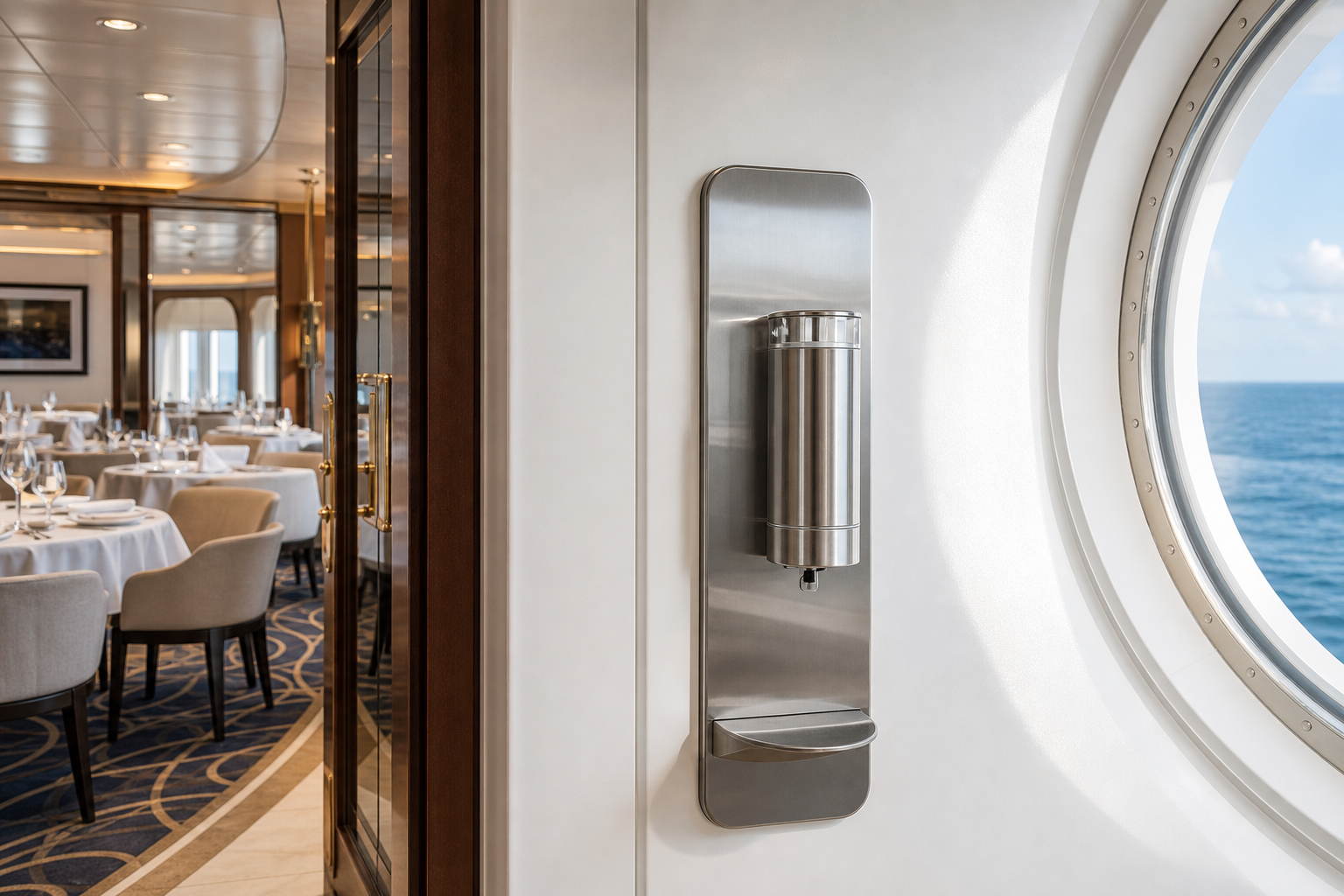
Prioritize soap and water over hand sanitizer. Alcohol-based sanitizers are less effective against norovirus than they are against bacteria. The CDC recommends soap and water, especially before eating and after using restrooms. Every major cruise line maintains hand-washing stations at buffet entrances for this reason.
Be especially careful during the first 48 hours. Embarkation day and the night that follows represent your highest-exposure window. Wash hands before and after handling buffet serving utensils. Avoid touching your face in high-traffic common areas.
Report symptoms the moment they start. If you develop nausea or diarrhea, contact the ship’s medical center immediately. Most major lines offer confidential early-reporting programs, and the earlier a case is documented, the sooner the crew can initiate containment procedures. Initial consultations are typically covered at no charge on most major lines.
Decline to push through it. The instinct to not “waste” a vacation day by staying in the cabin when you feel a little off is understandable. It is also how a single infectious person becomes a full shipboard outbreak. Voluntary isolation during the first 24 hours of symptoms is the single most effective thing a sick passenger can do for everyone aboard.
For a full prevention checklist, our dedicated guide on how to avoid norovirus on a cruise walks through every practical step.
You might also find our guide on how to avoid seasickness on a cruise useful — the early symptoms of motion sickness and norovirus overlap significantly, and knowing which one you are dealing with helps you respond correctly.
What to Do If a Norovirus Outbreak Happens on Your Sailing
Even on a well-run ship, outbreaks occur. Here is what to expect and how to navigate one.
Enhanced sanitation protocols activate quickly. Once a ship’s medical team identifies a gastrointestinal illness cluster approaching the threshold, most lines shift to what they call enhanced sanitation mode. Buffet service transitions to crew-served rather than self-serve; handrails, elevator buttons, and restroom fixtures are disinfected more frequently; and some common-area seating may be removed or restricted.
Ill passengers are asked to isolate. Passengers who report gastrointestinal symptoms are typically requested — and sometimes required — to remain in their cabins for 24 to 48 hours after their last episode. Meals are delivered to the cabin during this period, usually without the standard room service delivery fee.
The CDC is notified in real time. If illness reports cross the 3% threshold, the ship’s medical officer is required to notify the CDC VSP while the ship is still at sea. The CDC may dispatch inspectors at the next U.S. port call. The investigation report will eventually appear in the public VSP database.
Compensation is not guaranteed. Standard cruise contracts of carriage do not obligate lines to compensate passengers for illness outbreaks. Some lines offer future cruise credits on a discretionary basis when a sailing is severely disrupted, but this is not standard practice. Travel insurance with a medical and trip-interruption component provides more reliable coverage.
Document your experience. If you become ill, visit the medical center and request a written record of your visit. This matters for travel insurance claims and, in rare cases involving serious complications, any follow-up with the cruise line.
The Bottom Line Before You Book
The cruise lines appearing most often in CDC VSP outbreak records are the lines that carry the most passengers. That is the summary finding of every serious analysis of the VSP database, and it is the conclusion the CDC’s own published context supports.
What matters more than raw outbreak counts when choosing a line:
- The ship’s most recent Green Sheet VSP sanitation inspection score, available at cdc.gov/vessel-sanitation
- Whether the cruise line maintains a robust onboard illness reporting and medical response protocol
- Your own hygiene habits during the first 48 hours of a sailing, when most norovirus introductions occur
If you want to know whether cruise ships are safe overall — including crime statistics, capsizing odds, and how cruise safety compares to flying — that guide puts norovirus risk in context alongside every other hazard at sea. For a complete picture of how cruise ships handle health risks — including inspection score histories, onboard medical capabilities, and how cruise safety compares to other forms of travel — visit our full Cruise Health & Safety guide.