
The Biggest Cruise Lines in the World, Ranked by Fleet and Capacity
The biggest cruise lines ranked by fleet size, passenger capacity, and ships. Royal Caribbean, Carnival, MSC, Norwegian, and Disney compared with real data.
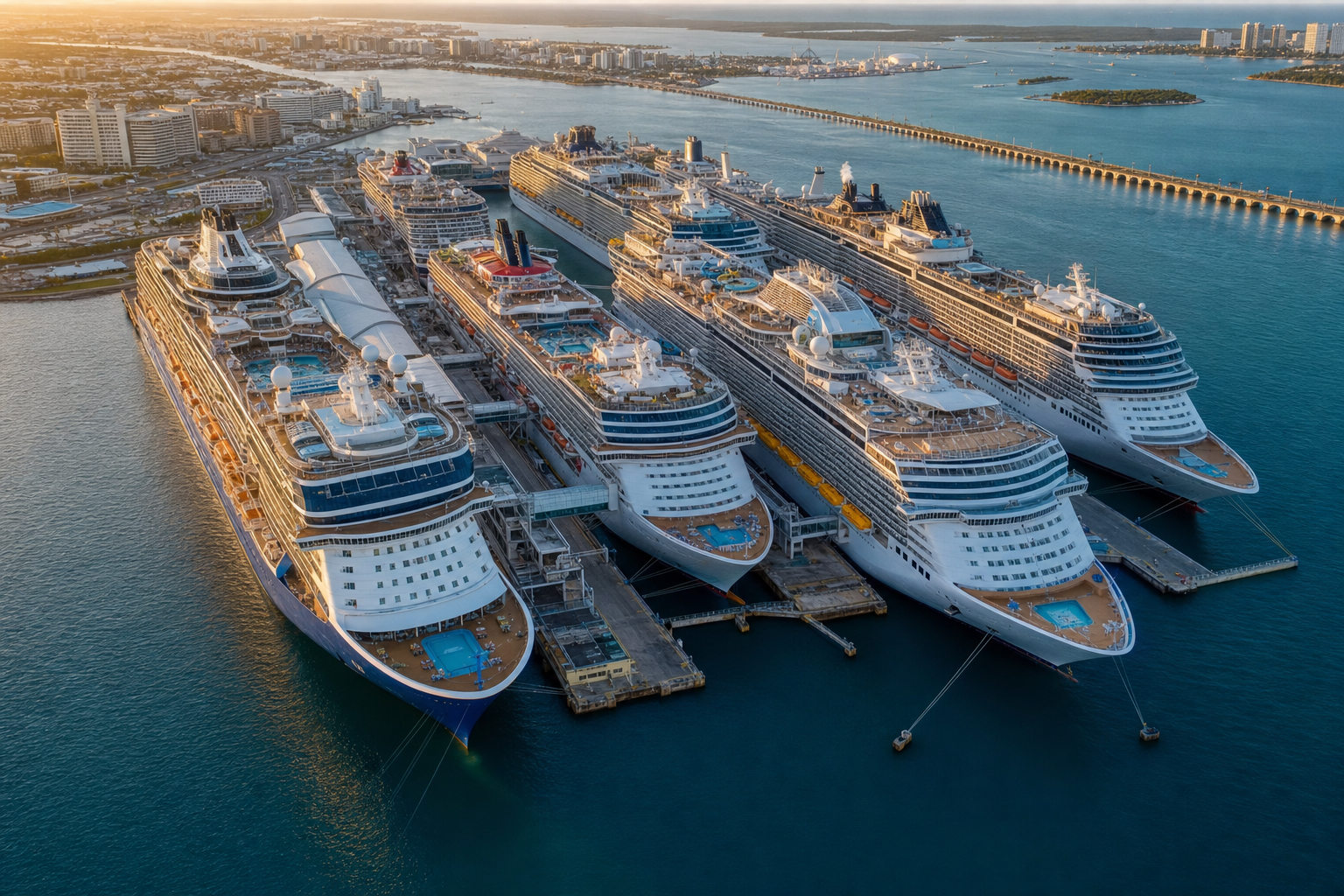
The Biggest Cruise Lines in the World, Ranked by Fleet and Capacity
The biggest cruise line in the world by total passenger capacity is Royal Caribbean International, with a fleet of roughly 28 ships capable of carrying more than 100,000 guests at sea simultaneously. Carnival Cruise Line is the largest by sheer number of ships (around 27 active vessels), while Carnival Corporation & plc — the parent company — is the single largest cruise corporation on earth, operating nine distinct brands and more than 90 ships. MSC Cruises is the fastest-growing major line, Norwegian Cruise Line is the largest premium-contemporary hybrid, and Disney Cruise Line is the dominant family-luxury player despite its comparatively small fleet.
Whether you are shopping for a first-time vacation or building a comprehensive understanding of the industry, knowing how the biggest cruise lines stack up helps you choose the experience that fits you best. Bigger lines mean more itinerary options, larger ships with more onboard amenities, and — in most cases — stronger pricing power. Our Cruise Lines Guide covers the full landscape; this article drills into the size rankings specifically.
We have cross-referenced Cruise Lines International Association (CLIA) industry reports, individual cruise line fleet pages, and public annual-report disclosures to compile the data below. Fleet compositions change as ships are ordered, delivered, and retired, so treat figures as accurate to mid-2026 and check each line’s official fleet page before booking.
What Makes a Cruise Line “Big”?
“Biggest” is not a single number. Depending on what you care about, a different line wins:
- Number of ships — how much choice and scheduling flexibility exists
- Total lower berth capacity (TALB) — the industry-standard passenger-count metric, summing the double-occupancy capacity of every cabin
- Gross tonnage (GT) — the internal volume of the fleet, a proxy for onboard space and amenity richness
- Annual passengers carried — real throughput, which differs from capacity because not every ship sails full every sailing
- Revenue — the commercial footprint of the parent company
A line can rank #1 on one metric and #3 on another. The table in the next section captures all five dimensions so you can see exactly where each major player leads.
The Biggest Cruise Lines Ranked: Master Comparison Table
The figures below reflect publicly disclosed fleet data and CLIA industry reports through early 2026. Note that CLIA membership figures and individual line reports occasionally use slightly different methodologies; we have used the most conservative confirmed figure where ranges appear in source materials.
| Rank | Cruise Line | Active Ships | Est. Total Capacity (TALB) | Largest Ship | Parent Company |
|---|---|---|---|---|---|
| 1 | Royal Caribbean International | ~28 | ~105,000 | Icon of the Seas (7,600 guests) | Royal Caribbean Group |
| 2 | Carnival Cruise Line | ~27 | ~82,000 | Carnival Jubilee (6,500 guests) | Carnival Corporation & plc |
| 3 | MSC Cruises | ~22 | ~73,000 | MSC World America (6,762 guests) | MSC Group (private) |
| 4 | Norwegian Cruise Line | ~19 | ~60,000 | Norwegian Prima / Viva class (~3,100 guests) | Norwegian Cruise Line Holdings |
| 5 | Disney Cruise Line | ~8 | ~22,000 | Disney Treasure (~4,000 guests) | The Walt Disney Company |
By parent corporation (combined brands):
| Parent | Brands | Combined Fleet | Combined Capacity (approx.) |
|---|---|---|---|
| Carnival Corporation & plc | Carnival, Princess, Holland America, P&O UK, P&O Australia, Costa, AIDA, Cunard, Seabourn | 90+ ships | ~250,000 berths |
| Royal Caribbean Group | Royal Caribbean, Celebrity, Silversea | 65+ ships | ~155,000 berths |
| Norwegian Cruise Line Holdings | Norwegian, Oceania, Regent Seven Seas | 30+ ships | ~75,000 berths |
| MSC Group | MSC Cruises | 22+ ships | ~73,000 berths |
| Disney / Independent | Disney Cruise Line and various luxury/expedition independents | varies | varies |
Royal Caribbean International: The Biggest Single Cruise Brand
Royal Caribbean has held the title of largest single cruise brand by passenger capacity for years, and the 2024 delivery of Icon of the Seas — the largest cruise ship ever built at 248,663 gross tons — widened that lead considerably. Icon can carry approximately 7,600 guests at double occupancy and up to 9,000 at full capacity, numbers that are without precedent in maritime history.
When we sailed Royal Caribbean’s Wonder of the Seas during a Western Caribbean itinerary, the sheer scale was immediately apparent: 18 decks, eight distinct “neighborhoods,” and more than 20 dining venues. The line’s operational philosophy is that a bigger ship can deliver a more diverse onboard product — and at that size, it largely does.
Royal Caribbean Fleet Snapshot
- Fleet size: approximately 28 ships (mid-2026)
- Flagship: Icon of the Seas (248,663 GT, delivered January 2024)
- Newest deliveries: Star of the Seas (Icon class, expected August 2025); additional Icon-class vessels on order through 2028
- Home ports: Miami, Port Canaveral, Galveston, Baltimore, Seattle, Barcelona, Southampton, and more than a dozen others globally
- Parent: Royal Caribbean Group (NYSE: RCL), which also owns Celebrity Cruises and Silversea Cruises
Royal Caribbean Group’s combined capacity across Royal Caribbean International, Celebrity, and Silversea exceeds 155,000 berths — making the group the second-largest corporation in cruising after Carnival Corporation.
Carnival Cruise Line: Most Ships, Broadest Value Reach
Carnival Cruise Line consistently operates the largest number of individual ships of any single brand. With roughly 27 active vessels in mid-2026, Carnival also dominates the value-contemporary segment — the entry-level tier that accounts for the majority of first-time cruisers in North America.
Carnival’s newest flagship, Carnival Jubilee, is a 181,500 GT Excel-class ship home-ported in Galveston, Texas, carrying approximately 6,500 guests. The Excel class (Mardi Gras, Carnival Celebration, Carnival Jubilee) represents Carnival’s most significant capacity expansion in decades, adding roughly 20,000 new berths across three ships.
Carnival Cruise Line Fleet Snapshot
- Fleet size: approximately 27 ships
- Flagship: Carnival Jubilee (181,500 GT)
- Most recent delivery: Carnival Jubilee (2023); additional ships on order
- Home ports: Port Canaveral, Miami, Galveston, New Orleans, Long Beach, Baltimore, Norfolk
- Parent: Carnival Corporation & plc (NYSE/LSE: CCL/CUK)
Carnival Corporation as a whole is the single largest cruise company in the world. Its nine brands span every market segment from budget-contemporary (Carnival, Costa, AIDA) through premium (Holland America, P&O) to ultra-luxury (Seabourn, Cunard). For a full breakdown of which lines fall under which parent, see our guide to the cruise line family tree.
MSC Cruises: The Fastest-Growing Major Line
MSC Cruises is privately owned by the Geneva-based MSC Group (Mediterranean Shipping Company) and has grown from a niche European operator into a genuine global force in less than two decades. The line’s order book is among the most aggressive in the industry: it has delivered multiple Meraviglia-class and World-class ships in rapid succession, with MSC World America entering service in 2025 at 331 meters long and carrying approximately 6,762 guests — MSC’s largest ship to date.
MSC’s expansion into the North American market accelerated with the opening of its dedicated Ocean Cay MSC Marine Reserve private island in the Bahamas, and with World America’s home port in Miami, the line is now a direct competitor for the mainstream Caribbean market that Carnival and Royal Caribbean have long dominated.
MSC Cruises Fleet Snapshot
- Fleet size: approximately 22 ships (mid-2026)
- Flagship: MSC World America (2025 delivery)
- Recent/upcoming deliveries: MSC World Europa (2022), MSC World America (2025); additional World-class vessels on order
- Key markets: Mediterranean, Caribbean, Northern Europe, South America
- Parent: MSC Group (privately held; no public financials)
Because MSC is privately held, total revenue figures are not publicly disclosed. Based on capacity alone, however, it ranks firmly third among individual cruise brands.
Norwegian Cruise Line: Leader in the Premium-Contemporary Segment
Norwegian Cruise Line pioneered “Freestyle Cruising” — the elimination of fixed dining times and dress codes — and parlayed that positioning into the largest fleet in the premium-contemporary tier. Norwegian’s roughly 19 ships in 2026 span from older mid-size vessels to the newer Prima-class ships, which introduced a more design-forward aesthetic and intentionally smaller capacity (approximately 3,100 guests) to command higher per-person revenue.
Norwegian Cruise Line Holdings (NCLH, NYSE) also owns Oceania Cruises (upper-premium small ships) and Regent Seven Seas Cruises (all-inclusive ultra-luxury). Combined, the three brands operate approximately 30+ ships with a combined capacity near 75,000 berths.
Norwegian Cruise Line Fleet Snapshot
- Fleet size: approximately 19 ships
- Newest vessels: Norwegian Prima (2022), Norwegian Viva (2023); additional Prima-class vessels planned
- Signature ships: Norwegian Bliss, Norwegian Encore (Breakaway Plus class, ~4,000 guests each)
- Home ports: Miami, Port Canaveral, New York, Seattle, Los Angeles, Southampton, Barcelona
- Parent: Norwegian Cruise Line Holdings (NYSE: NCLH)
Disney Cruise Line: Small Fleet, Maximum Impact
Disney Cruise Line is the smallest line in this ranking by fleet size, but it commands premium pricing and brand loyalty that is unmatched in family cruising. The line launched in 1998 with two ships (Disney Magic and Disney Wonder) and has since grown to approximately eight ships, with Disney Treasure — a Wish-class vessel — delivering in late 2024.
Disney’s fleet expansion has been deliberate rather than aggressive: the line adds ships on a 2–3-year cadence and prices them significantly above comparable Carnival or Royal Caribbean itineraries. A 7-night Disney Bahamas sailing from Port Canaveral can run 40–60% more than a comparable Norwegian or Carnival itinerary, according to fare comparisons we pulled from the respective booking engines.
Disney Cruise Line Fleet Snapshot
- Fleet size: approximately 8 ships (mid-2026)
- Newest ships: Disney Wish (2022), Disney Treasure (late 2024)
- Flagship experience: Castaway Cay (Disney’s private Bahamian island)
- Home ports: Port Canaveral (primary), Miami, Los Angeles, Galveston, Vancouver, Barcelona
- Parent: The Walt Disney Company (NYSE: DIS)
Disney’s small fleet is a strategic choice: scarcity supports premium pricing, and the line’s private island infrastructure (Castaway Cay; Lookout Cay at Lighthouse Point opened 2024) requires capital investment that benefits from a focused deployment.
How the Industry Consolidated: A Brief History
Today’s big-three corporate structure — Carnival Corporation, Royal Caribbean Group, and Norwegian Cruise Line Holdings — is the product of roughly four decades of mergers and acquisitions.
- 1972: Carnival Cruise Line founded by Ted Arison with a single refurbished ship (TSS Mardi Gras). The line that would become the largest cruise corporation in history started with one vessel.
- 1987–1990: Royal Caribbean goes public; Carnival Corporation acquires Holland America Line (1989) and stakes in other European lines.
- 1997: Disney Cruise Line launches, bringing the first major theme-park brand into cruising.
- 2002–2003: Carnival Corporation and P&O Princess complete a landmark merger, forming the industry’s largest corporation. The merged entity controls roughly 40% of global cruise capacity at closing.
- 2007–2012: Norwegian Cruise Line changes hands multiple times before Norwegian Cruise Line Holdings goes public in 2013 under Apollo Global Management and TPG Capital backing.
- 2014–2019: Royal Caribbean acquires a 67% stake in Silversea; MSC Cruises accelerates its newbuild program and begins competing directly in North America.
- 2020: The COVID-19 pandemic halts all cruise operations globally for 5–15 months depending on the line. Industry-wide capacity drops to zero; lines retire older ships and emerge leaner.
- 2022–2025: Post-pandemic demand surge produces record bookings across all major lines. Royal Caribbean’s Icon of the Seas, MSC World America, and Carnival’s Excel class deliver simultaneously, adding more than 50,000 new berths to the global fleet.
What Fleet Size Means for You as a Traveler
Understanding which line is “biggest” is not just trivia — it has practical implications for your vacation.
More Ships = More Itinerary Flexibility
A line with 27 ships can home-port vessels in a dozen cities simultaneously, meaning you can often find a Carnival or Royal Caribbean sailing from a port within driving distance of your home. Disney, with eight ships, concentrates primarily in Port Canaveral, which is excellent if you live in Florida but requires a flight for most of the country.
Bigger Ships = More Onboard Amenities
The correlation between ship size and amenity count is strong. Icon of the Seas carries six water slides, a surf simulator, ice skating, a full Broadway-style theater, and 40+ dining venues. A mid-size ship of 90,000 GT typically offers a fraction of that variety. If onboard entertainment and dining breadth are priorities, the largest ships win by a wide margin.
Pricing Power and Deals
The biggest lines carry the most inventory, which means they run the deepest promotions during slow booking periods. Carnival and Royal Caribbean regularly offer “kids sail free,” drink-package bundling, and early-booking discounts that smaller lines cannot match at scale. For deal hunters, a larger fleet means more opportunities. Our comparison of the best cruise lines covers how these lines stack up on value across all tiers.
Private Island Access
Size enables investment in private island infrastructure. Royal Caribbean’s Perfect Day at CocoCay (Bahamas) is a $250-million-plus development that can host an entire ship’s worth of guests simultaneously. Carnival has its own private beach clubs and pier access at several Caribbean ports. Disney’s Castaway Cay and Lookout Cay are purpose-built for the line’s ships. Smaller lines typically rely on shared public ports.
Frequently Asked Questions
Which is the biggest cruise line in the world?
By individual brand passenger capacity, Royal Caribbean International is the biggest cruise line in the world, with Icon of the Seas being the single largest cruise ship ever built (248,663 GT, ~7,600 guests). By parent corporation, Carnival Corporation & plc is the largest cruise company, operating nine brands and 90+ ships.
Which cruise line has the most ships?
Carnival Cruise Line operates approximately 27 active ships as of mid-2026, making it the single brand with the largest number of vessels. Carnival Corporation as a whole operates 90+ ships across its nine brands.
Is MSC bigger than Royal Caribbean?
Not yet, but MSC is closing the gap. Royal Caribbean International leads on total passenger capacity with its Icon-class megaships, but MSC’s aggressive orderbook means it could rival Royal Caribbean in total berths by the end of the decade if current building plans hold.
How big is Disney Cruise Line compared to other lines?
Disney operates approximately 8 ships, making it the smallest of the five major lines in this ranking. However, Disney’s per-ship revenue and brand premium are among the highest in the industry. It is big in influence and pricing power, small in fleet size by design.
The Bottom Line
The biggest cruise line in the world depends on your yardstick. Royal Caribbean International wins on single-brand passenger capacity and largest individual ship. Carnival Corporation wins as a corporate entity, controlling nearly 40% of global ocean-cruise capacity. MSC Cruises is the fastest-growing threat to that duopoly. Norwegian leads the premium-contemporary tier. And Disney remains the undisputed king of family luxury despite its compact fleet.
Each line’s size reflects a deliberate strategic choice about who it is trying to serve and at what price point. For a deeper look at how these lines compare on food, entertainment, value, and service — not just size — head to our full best cruise lines comparison, and check our Cruise Lines Guide for the complete topical breakdown by destination, ship class, and travel style.
Fleet sizes and capacities reflect publicly available data through mid-2026. Cruise lines continuously add, transfer, and retire ships; check the respective line’s official fleet page for the most current information.