
China's Second Homegrown Cruise Ship Hit the Water Today — and It's Bigger Than Anyone Expected
The Adora Flora City was floated out in Shanghai on March 20, 2026, marking a milestone in China's push to build a homegrown cruise industry capable of competing globally.
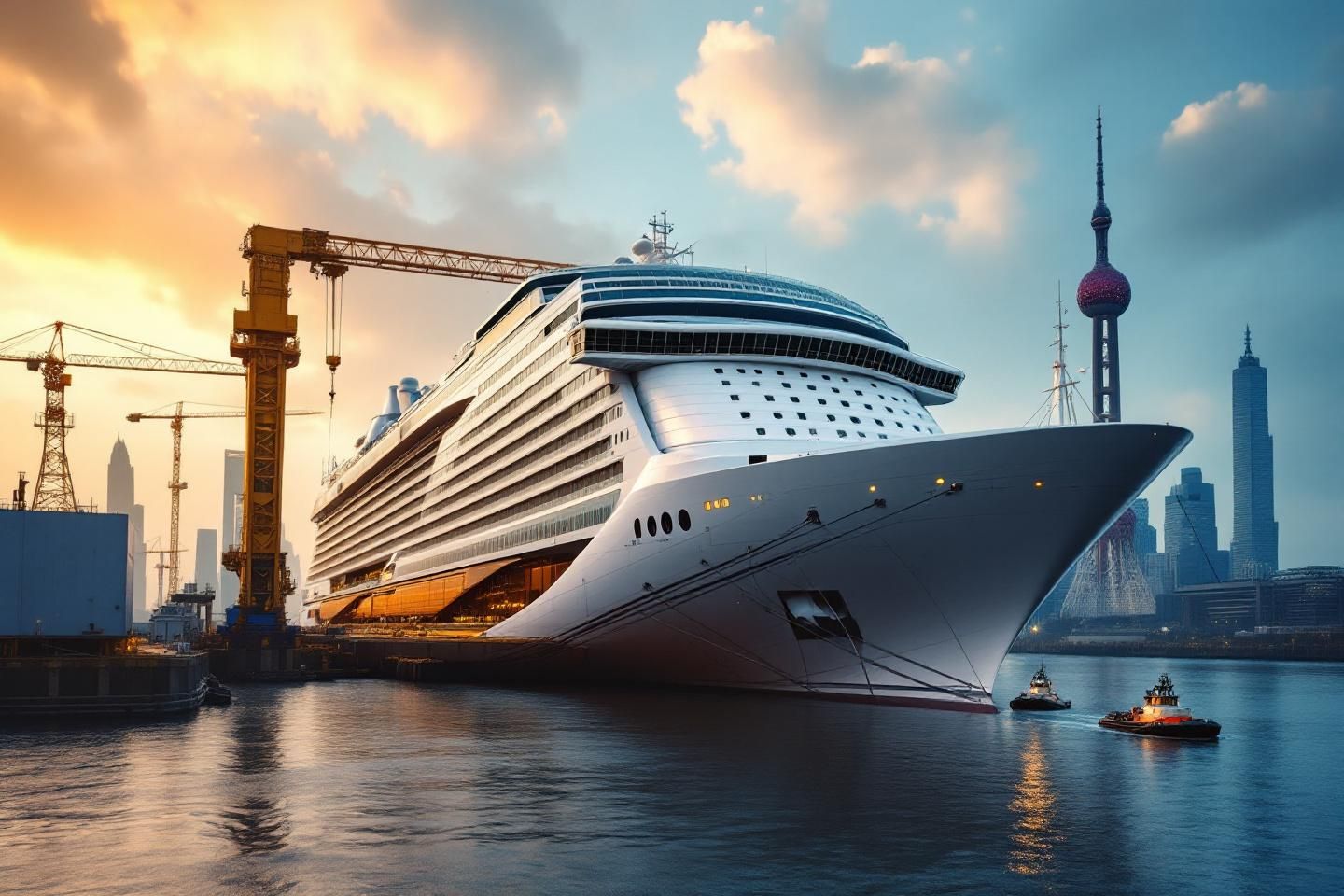
China’s second domestically built mainstream cruise ship touched water for the first time today. On March 20, 2026, the Adora Flora City was floated out of its construction dock at Shanghai Waigaoqiao Shipyard — the same facility that produced its predecessor — and guided into the Huangpu River by a fleet of tugboats. Cruise Industry News reported the floatout as it happened, and the significance of this moment extends well beyond the ceremony.
This isn’t just a ship launch. It’s the latest evidence that China’s ambition to build a self-sufficient cruise industry — one not dependent on European shipyards or Western operators — is advancing on schedule.
A Ship Designed to Outgrow Its Predecessor
The Adora Flora City is larger than any cruise ship China has built before. At 17.4 meters longer than its sister ship, the Adora Magic City, and with a total of 2,130 cabins capable of accommodating up to 5,232 guests, the Flora City represents a meaningful step up in both capacity and ambition.
For context, the Adora Magic City was already a landmark achievement when it debuted — the first large contemporary cruise ship ever designed and built entirely in China, without the technical scaffolding of a joint venture with a European yard. Flora City builds on that foundation and expands it.
The vessel was constructed at Shanghai Waigaoqiao Shipbuilding Co., Ltd., a subsidiary of China State Shipbuilding Corporation (CSSC) — the same state-owned industrial giant that anchors China’s entire shipbuilding strategy. CSSC’s involvement signals that this is not a speculative commercial venture. It is a national infrastructure project with political will and industrial capacity behind it.
What “Floatout” Actually Means
For readers unfamiliar with the shipbuilding process, a floatout is a critical milestone. The ship has been built in a dry dock — essentially a sealed basin — and water is now introduced to allow the hull to float freely for the first time. From here, the vessel moves to a fitting-out berth where the interior work begins: installing cabins, restaurants, theaters, mechanical systems, and all the infrastructure that transforms a steel hull into a functioning cruise ship.
The Adora Flora City is now entering that interior outfitting and system commissioning phase. Delivery is scheduled for the end of 2026, after which the ship will begin international voyages departing from Guangzhou. That timeline is ambitious but consistent with what CSSC has demonstrated it can execute.
Flower Themes, Chinese Culture, and Smart Technology
Adora Cruises has leaned hard into cultural differentiation as its competitive positioning. The Flora City’s design is built around a flower theme running throughout the ship’s visual identity, dining venues, and entertainment spaces. This is a deliberate departure from the generic mid-century nautical aesthetic that still dominates much of the global cruise fleet.
The dining program will showcase regional Chinese cuisine across multiple venues, and onboard performances are designed to highlight traditional Chinese art forms. Adora’s stated “Cruise + Culture” strategy is not marketing shorthand — it reflects a genuine belief that Chinese cruisers want something that feels authentically Chinese, not a watered-down version of a Carnival or Royal Caribbean product.
The ship also incorporates what Adora describes as advanced smart and AI technologies, including systems designed to personalize the guest experience at the cabin level. Energy-efficient systems and sustainable materials are built into the design. Whether these claims translate meaningfully into the onboard experience remains to be seen at delivery, but the emphasis on technology reflects the broader priorities of China’s state industrial sector.
Roger Chen’s Vision, Stated Plainly
Adora Cruises CEO Roger Chen did not understate the moment. “Our vision is to build a flagship cruise company in China with significant international influence,” Chen said at the floatout ceremony, citing the fleet’s growth trajectory and the company’s commitment to refining the guest experience with each new vessel.
That phrase — “significant international influence” — deserves attention. Adora is not positioning itself solely as a domestic operator serving Chinese consumers on short coastal sailings. The deployment plan for the Flora City already includes international voyages from Guangzhou. The ambition is to compete in the same market segments as the European and American cruise giants, not just carve out a protected domestic niche.
Why the Rest of the Industry Is Watching
The global cruise industry has long treated Chinese shipbuilding as a future threat that remained perpetually in the future. The Adora Magic City changed that. Its commercial operation proved that China could build and operate a contemporary mainstream cruise ship. The Flora City confirms that the Magic City was not a one-off demonstration project.
Two ships does not make a fleet. But the trajectory is clear. CSSC has the production capacity, the state backing, and now the operational data from the Magic City to accelerate. If deliveries continue on schedule and the Flora City receives strong market response in its inaugural season, the case for a third — and larger — vessel becomes straightforward to make.
For the established cruise lines watching from Hamburg, Miami, and Genoa, the question is no longer whether Chinese-built cruise ships will compete internationally. The question is how quickly.
What Comes Next
The Adora Flora City will spend the next several months in outfitting before sea trials and final delivery. Adora has indicated that international itineraries from Guangzhou will begin shortly after delivery, with the ship designed to serve both the domestic Chinese market and Asian regional routes.
We will be watching the delivery closely. The floatout of a 5,200-passenger cruise ship built entirely in China, on schedule, in 2026 is exactly the kind of industry development that tends to look more significant in hindsight than it does in the moment. Today is one of those moments.
Source: Cruise Industry News — Adora Flora City Touches Water for First Time in Shanghai