
Royal Caribbean Wants to Build a Massive Ship Repair Yard in Panama — Here's Why It's a Big Deal
Royal Caribbean has proposed a 130,000-ton floating dry dock on Panama's Pacific coast, a move that could fundamentally change how the cruise industry maintains its mega-ships.
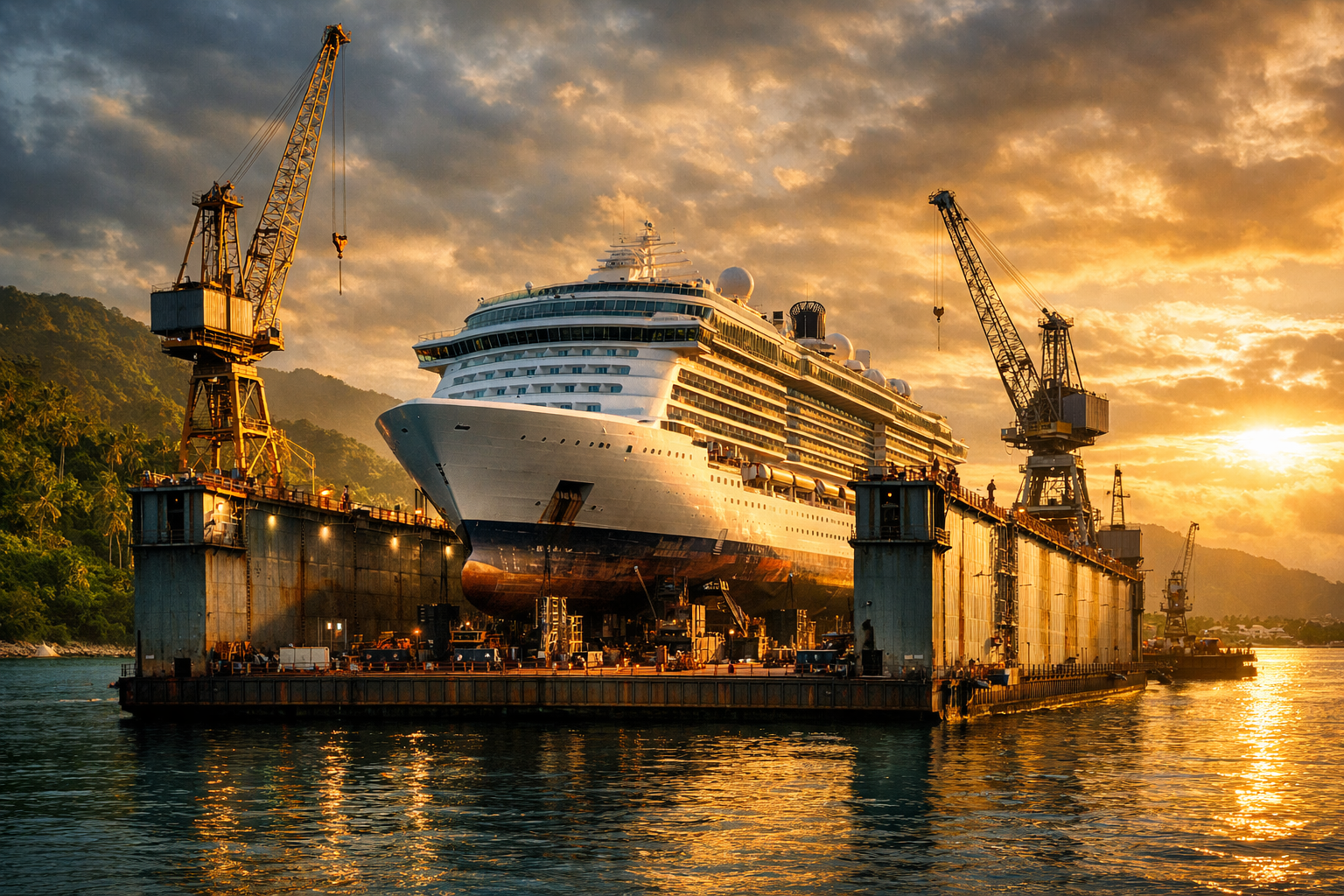
Most cruise news focuses on the ships passengers sail on — the pools, the restaurants, the new itineraries. But a story that landed this week is about the infrastructure happening entirely out of public view, and it could quietly reshape the entire cruise industry for decades to come.
According to The Maritime Executive, Royal Caribbean Group has proposed building a massive floating dry dock facility on Panama’s Pacific coast — a 130,000-ton structure stretching 400 meters (roughly 1,300 feet) in length. The proposed site is in the Punta Piedra area near Puerto Armuelles in Panama’s Chiriquí Province, close to the Costa Rican border. Royal Caribbean executives brought the proposal directly to Panamanian President José Raúl Mulino, who expressed support for the initiative and said “investments could start this year.”
The target for full operation: 2031.
The Problem Royal Caribbean Is Trying to Solve
To understand why this matters, you need to understand an unsexy but critical reality of the cruise business: mega-ships need regular dry docking for maintenance, inspections, and repairs, and right now, there simply aren’t enough facilities nearby to handle them.
Today, large cruise ships operating on the Pacific side of the Americas have to make the long journey to Asia for dry dock work. That’s a massive logistical burden — in time, in fuel, and in lost revenue from ships that aren’t sailing passengers. The existing Balboa shipyard in Panama can handle smaller vessels, but it’s not equipped for the enormous scale of modern mega-ships.
Royal Caribbean’s proposal would change that equation dramatically. A 130,000-ton floating dry dock of that size could service not just Royal Caribbean’s own fleet but also container ships and other large commercial vessels that face the same lack of regional options. The facility would essentially become a Pacific Coast hub for heavy maritime maintenance.
This Isn’t Royal Caribbean’s First Rodeo
What gives this proposal credibility is the company’s track record. In the 1990s, Royal Caribbean and Carnival Corporation co-invested in Grand Bahama Shipyard in the Bahamas — a facility that has since become a crucial dry dock resource for Atlantic-side cruise ships. That yard recently completed its first dry docking using a 357-meter East End dock capable of lifting 93,500 tons.
The Panama proposal is a Pacific equivalent of that same playbook: identify a strategic gap in the maritime infrastructure map, invest early, and build something that serves both commercial and operational interests over the long term.
What Panama Gets Out of It
Panama’s enthusiasm for the proposal isn’t hard to understand. The Chiriquí Province region near Puerto Armuelles has, by the Panamanian president’s own description, been economically neglected for years. The dry dock project is projected to generate between 500 and 800 skilled jobs — a significant injection for a region that has not shared equally in Panama’s maritime economy.
For a country already anchored by the Canal as its primary maritime identity, adding a world-class ship repair facility on the Pacific coast would meaningfully expand Panama’s position as a global maritime hub. President Mulino’s comment that investments could begin in 2026 signals that this isn’t just a concept — there’s political will to move it forward.
What It Means for Cruisers (and the Industry)
For passengers, the impact is indirect but real. Ships that spend less time and money on the complex logistics of traveling to Asia for dry dock work are ships that can be maintained more efficiently and returned to service faster. Dry docking a vessel is already a significant cost; reducing the round-trip distance involved makes a meaningful difference to the economics of operating a fleet.
More broadly, this is a signal of where the cruise industry sees its long-term center of gravity. Royal Caribbean operates extensively in the Caribbean and along Pacific Coast itineraries. Building repair infrastructure closer to those routes — rather than relying on facilities halfway around the world — is a strategic investment in the durability of that business.
The development phases are scheduled to run from 2026 through 2031. If the project proceeds, it won’t generate headlines the way a new ship christening does. But it may prove to be one of the more consequential decisions in cruise industry infrastructure this decade.