
Disney's Newest Ship Just Shattered a 118-Year-Old Panama Canal Record
Disney Adventure becomes largest cruise ship to transit Panama Canal, breaking Norwegian Bliss's 2018 record with 208,000 gross tons.
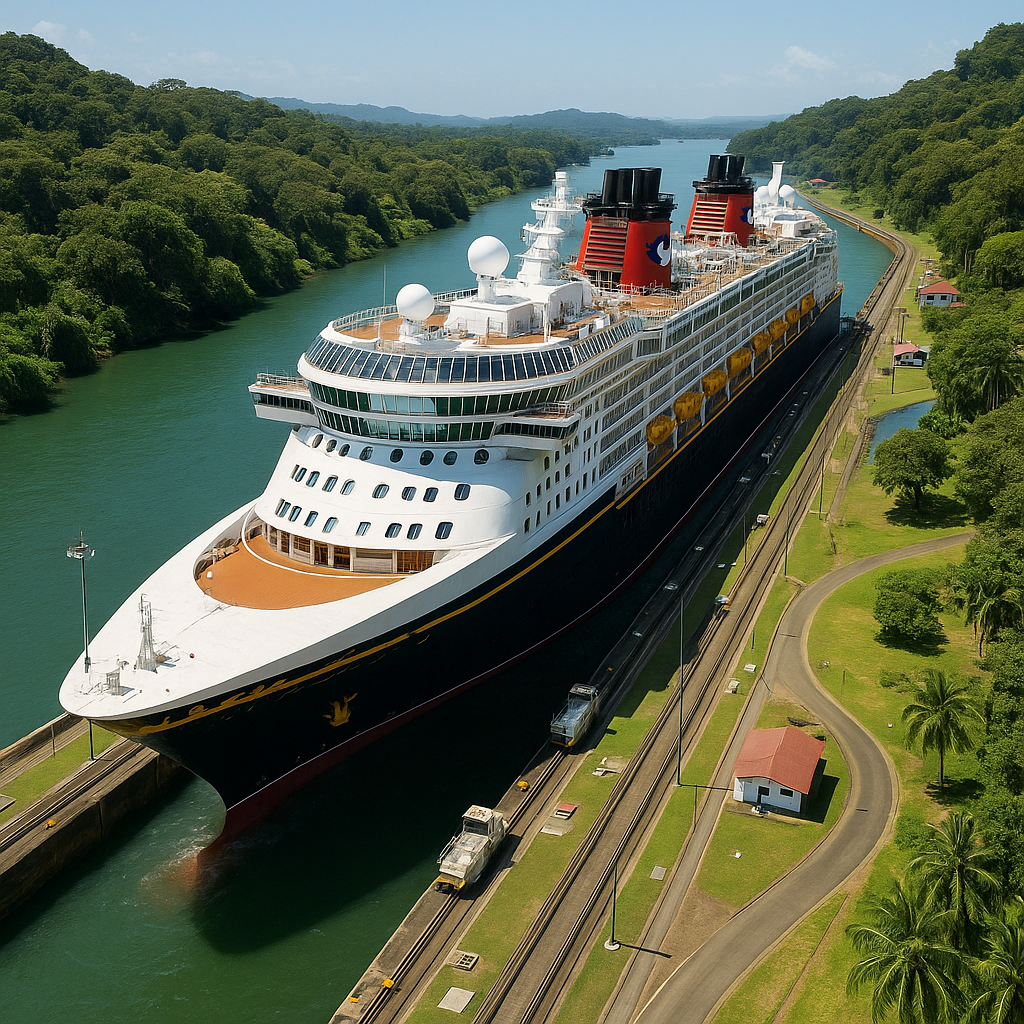
The Panama Canal has witnessed countless engineering marvels transit its locks since opening in 1914, but nothing quite like what happened on February 2, 2026. Disney Cruise Line’s newest vessel, the Disney Adventure, became the largest passenger ship by gross tonnage and capacity to ever squeeze through the historic waterway—a record that highlights just how massive modern cruise ships have become.
According to Cruise Industry News, the 208,000-gross-ton behemoth completed its inaugural transit of the interoceanic waterway as part of its positioning voyage to Singapore, where it will begin regular sailings in March. The ship measures 342 meters (1,122 feet) in length with a beam of 46.4 meters, carrying approximately 6,700 passengers—nearly 2,000 more than the previous record holder.
Breaking Norwegian’s Long-Standing Record
The Disney Adventure’s transit shatters a record held by Norwegian Cruise Line’s Norwegian Bliss since May 2018. That ship, impressive in its own right at 168,000 gross tons and carrying 5,000 passengers, held the title for nearly eight years. The Adventure’s 208,000 gross tons represents a 24% increase in size—a jump that illustrates the cruise industry’s relentless push toward larger vessels despite infrastructure constraints.
This milestone raises an interesting question about the future of canal transits. The Panama Canal Authority expanded the waterway in 2016 with new Neopanamax locks specifically designed to accommodate larger vessels, but even those locks have limits. The Disney Adventure doesn’t just edge past the previous record—it blows past it by 40,000 gross tons while carrying 34% more passengers.
What This Means for Cruise Ship Design
The Disney Adventure’s successful transit demonstrates that shipbuilders are maximizing every inch of available space within the canal’s physical constraints. The Neopanamax locks can accommodate vessels up to 366 meters long and 49 meters wide, which means Disney’s naval architects pushed the boundaries on tonnage and capacity while staying within dimensional limits.
Built at Meyer Werft’s shipyards in Germany and joining Disney’s fleet in 2025, the Adventure joins a growing roster of Neopanamax cruise ships. The Panama Canal Authority notes that over 40 Neopanamax vessels are expected to transit in 2026, with four other cruise ships completing inaugural transits this season alone. This surge reflects the industry’s strategic need to reposition massive ships between markets—particularly vessels heading to Asia, where Disney is betting big on the Singapore market.
Why Singapore Matters
The Disney Adventure’s destination tells its own story. Rather than sailing Caribbean or Alaskan waters like most Disney ships, the Adventure will be based in Singapore, operating three- and four-night itineraries at sea. This positioning signals Disney’s confidence in Asian cruise demand and its willingness to deploy one of its largest assets outside traditional Western markets.
The Panama Canal transit saves Disney weeks of sailing time and significant fuel costs compared to routing the ship around South America or Africa. For a vessel carrying 6,700 passengers and featuring attractions like “the longest roller coaster at sea,” operational efficiency matters. Every day saved in repositioning is another day the ship can generate revenue in Singapore.
The Engineering Behind the Record
What makes this transit particularly impressive isn’t just the ship’s size—it’s how close the Adventure comes to the locks’ maximum capacity. With only about 24 meters of length to spare and roughly 2.6 meters of beam clearance, the transit required precise navigation and expert canal pilots. The Panama Canal Authority highlighted the ship as “the largest passenger vessel by capacity and gross tonnage ever to transit the interoceanic waterway,” emphasizing both metrics because they tell different stories about the vessel’s scale.
Gross tonnage measures internal volume rather than weight, reflecting the ship’s enormous passenger capacity, entertainment venues, dining spaces, and that headline-grabbing roller coaster. The 208,000-gross-ton figure means the Adventure packs more internal space than any previous cruise ship to make the crossing—space filled with thousands of guests and the amenities they expect from a premium Disney experience.
What’s Next for Panama Canal Records?
With the Adventure now holding the record, the question becomes: how long will it stand? The cruise industry shows no signs of slowing its pursuit of larger vessels, but the Panama Canal’s physical dimensions create a hard ceiling. Unless the canal undergoes another expansion—an enormously expensive proposition with no current plans—future record-breaking transits will likely involve incremental increases in tonnage rather than the dramatic leap the Adventure represents.
The Disney Adventure’s successful transit proves that maximizing capacity within existing infrastructure remains possible, but we may be approaching the practical limits of what can safely navigate the Panama Canal. Future mega-ships exceeding these dimensions will need to choose their deployment markets carefully, potentially limiting Asian or European repositioning options.
For now, the Disney Adventure holds a record that won’t be easily broken—and serves as a remarkable bookmark in both cruise ship evolution and Panama Canal history.