
The Cruise Industry's $76.5 Billion Bet: 74 New Ships Will Reshape Ocean Travel Through 2036
The cruise industry is making an unprecedented investment in its future, with 74 new vessels currently on order representing a staggering $76.5 billion commitment that will add over 205,250 berths to global fleets through 2036.
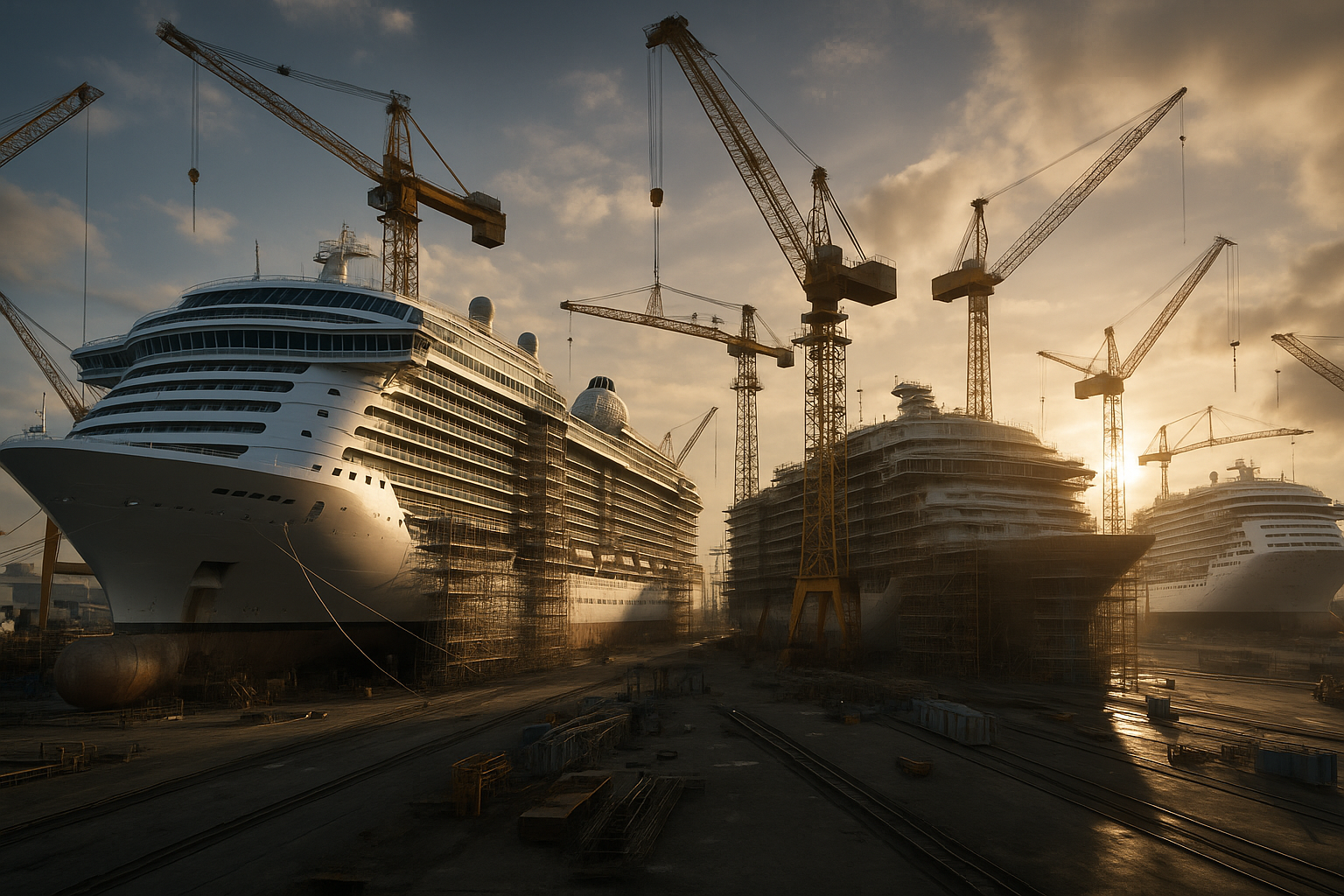
The cruise industry is making an unprecedented investment in its future, with 74 new vessels currently on order representing a staggering $76.5 billion commitment that will add over 205,250 berths to global fleets through 2036. This massive orderbook signals the industry’s confidence in continued growth despite recent global challenges, positioning major cruise lines to capture demand for the next decade.
According to data from the Cruise Industry News Global Cruise Ship Orderbook, two cruise giants are leading this expansion: MSC Cruises and Norwegian Cruise Line Holdings each have 14 ships on order—the largest orderbooks in the industry. This arms race in shipbuilding reflects not just competition between brands, but a fundamental transformation of how we’ll experience ocean travel in the coming years.
The Numbers Behind the Boom
The scale of this investment is difficult to comprehend. At $76.5 billion, the cruise industry’s current orderbook exceeds the GDP of many countries. These 74 vessels will add more than 205,250 new berths—equivalent to creating floating cities capable of housing populations larger than many metropolitan areas.
To put this in perspective, the industry is effectively doubling down on its pre-pandemic trajectory. Despite the existential threat cruising faced during COVID-19, these orders demonstrate that cruise lines see massive untapped demand in the decades ahead.
The ships range from intimate expedition vessels to mega-ships that will rank among the largest passenger vessels ever constructed. This diversity in the orderbook suggests cruise lines are targeting every segment of the market, from luxury seekers to value-conscious families.
MSC Cruises: Building a Mediterranean Empire
MSC Cruises’ 14-ship orderbook represents one of the most aggressive expansion plans in maritime history. The company is adding over 57,000 berths to its fleet by 2033, effectively creating capacity equivalent to adding an entire mid-sized cruise line to the market.
The crown jewel of MSC’s near-term plans is the MSC World Asia, scheduled to arrive in December 2026. At 216,638 gross tons with capacity for 6,758 passengers at double occupancy, the World Asia will be the line’s third World-Class vessel, following MSC World Europa and MSC World America.
Interestingly, despite its name suggesting an Asian deployment, the MSC World Asia will actually debut in the Mediterranean—a reminder that these mega-ships are designed for global flexibility, able to shift between markets as demand dictates.
MSC’s strategy includes a new class of ships recently ordered from Meyer Werft shipyard in Germany, with four vessels starting in 2030. This partnership with one of Europe’s premier shipbuilders signals MSC’s commitment to maintaining cutting-edge vessel technology and design.
The company’s willingness to invest so heavily suggests confidence not just in European markets, but in emerging cruise destinations worldwide. As traditional Caribbean and Mediterranean itineraries become saturated, these new ships will help MSC pioneer new routes and homeports.
Norwegian Cruise Line Holdings: Expanding Across Three Brands
Norwegian Cruise Line Holdings (NCLH) matches MSC with 14 ships on order, but spreads this investment across three distinct brands: Norwegian Cruise Line, Oceania Cruises, and Regent Seven Seas Cruises. This multi-brand strategy allows NCLH to compete in premium, luxury, and contemporary segments simultaneously.
With all vessels being built at Italy’s Fincantieri shipyard, NCLH’s orderbook is valued at over $19 billion and includes roughly 45,000 additional berths. The partnership with Fincantieri—one of the world’s most respected cruise ship builders—ensures consistency in quality and design across the portfolio.
The Norwegian Luna, arriving in March 2026, will be the fourth ship in the line’s Prima class at 156,300 gross tons with capacity for 3,571 passengers. The Luna is a “Prima Plus” variant, about 10% larger than the first two Prima-class ships, demonstrating how Norwegian continues to refine and improve even within a single ship class.
Looking further ahead, Norwegian’s orderbook reveals an evolution in ship design. Two additional Prima Plus vessels arrive in 2027 and 2028 (169,000 gross tons, 3,650 passengers each), followed by a dramatic leap to an entirely new large class. Starting in 2030, Norwegian will take delivery of massive 225,000-gross-ton ships with 5,100-passenger capacity in 2030, 2032, 2034, and 2036.
These mega-ships represent a significant bet on scale. At 225,000 gross tons, they’ll rival the largest ships currently sailing and will require Norwegian to develop new homeport infrastructure and operational capabilities.
The Other Major Players
While MSC and Norwegian dominate the orderbook by ship count, other cruise lines are making strategic investments that will reshape their competitive positions.
Carnival Corporation currently has seven ships on order for delivery through 2033, including vessels ranging from 4,200 to 6,200 passengers across two brands: Carnival Cruise Line and AIDA Cruises. Carnival’s more modest orderbook reflects its position as the world’s largest cruise company—with already substantial capacity, it can afford a measured approach to expansion.
Viking will welcome ten new ships to its fleet by 2031, continuing its rapid expansion from river cruising into ocean voyages. Viking’s growth strategy targets the premium small-ship segment, appealing to travelers who want destination-focused itineraries without mega-ship crowds.
Disney Cruise Line currently has five ships on order, representing the company’s most aggressive maritime expansion ever. Disney’s investment reflects confidence that its premium family product can command rates justifying new ship construction, even as it moves beyond its traditional Caribbean strongholds.
What’s Arriving in 2026
The immediate future provides a preview of this orderbook materializing. Over 30,000 new berths will enter service in 2026, with 14 new ocean-going ships built at a cost of over $10 billion.
The 2026 arrivals span the industry’s full spectrum:
- Disney Adventure - Disney’s largest ship ever, marking its entry into new markets
- Norwegian Luna - The refined Prima Plus class bringing Norwegian’s signature Freestyle Cruising to more guests
- Orient Express Corinthian - Luxury sailing yacht revival of an iconic travel brand
- Four Seasons I - Ultra-luxury small ship from the renowned hotel company
- Explora III - MSC Group’s luxury expedition brand expansion
- Emerald Kaia and Emerald Raiya - Twin expedition vessels for destination-focused travelers
- Viking Mira and Viking Libra - Continuing Viking’s ocean fleet growth
- Mein Schiff Flow - TUI Cruises’ evolution of the German premium market
- MSC World Asia - The third World-Class mega-ship
- Legend of the Seas - Royal Caribbean’s newest addition
- Magellan Discoverer - Small expedition vessel for Antarctica
- Adora Flora City - Catering to the growing Chinese cruise market
- Seven Seas Prestige - Regent’s ultra-luxury all-suite ship
This diverse array of vessels demonstrates that the cruise industry isn’t simply building bigger versions of the same ships—it’s experimenting with new concepts, entering new segments, and adapting to changing consumer preferences.
What This Means for Cruise Travelers
For consumers, this massive orderbook has profound implications. First, it signals that cruise capacity will continue to grow faster than many other vacation segments, potentially leading to more competitive pricing as lines seek to fill berths.
Second, the diversity of ships being built means more choice. Whether you prefer intimate expedition vessels carrying 100 guests or mega-ships with every amenity imaginable, the next decade will bring options designed specifically for your travel style.
Third, newer ships typically offer better environmental performance. Many vessels in this orderbook feature LNG propulsion, advanced wastewater treatment, and energy-efficient designs that reduce the environmental impact of cruising.
However, this capacity boom also raises questions. Can the industry fill 205,250 new berths without cannibalizing existing ships? Will popular ports become even more crowded as these mega-ships deploy worldwide? And what happens to older vessels as new ones enter service?
The Risk and Reward
A $76.5 billion orderbook represents enormous risk alongside the potential rewards. Cruise lines are essentially betting that demand will continue growing for the next decade—a forecast that could be disrupted by economic recessions, geopolitical instability, or unforeseen global events.
The industry learned during the pandemic that ships represent both assets and liabilities. When travel stops, these multi-billion-dollar vessels become expensive problems rather than profit centers. Yet cruise lines have apparently concluded that the growth potential outweighs these risks.
Moreover, these orders create long-term competitive dynamics. Companies with newer, more efficient ships can offer better experiences at lower costs, potentially forcing lines with aging fleets to invest in costly refurbishments or face market share losses.
Looking Ahead
As the cruise industry enters 2026 with this record orderbook, we’re witnessing a transformation of ocean travel. The ships being built today will define cruising through the 2030s, introducing new technologies, amenities, and itineraries that we can only begin to imagine.
For cruise enthusiasts, this represents an exciting era. The competition driving these investments will benefit consumers through better ships, more competitive pricing, and innovative experiences. For the industry, it’s a high-stakes bet that cruising’s best years lie ahead—and based on these orderbook numbers, that’s a bet they’re willing to back with tens of billions of dollars.
The question now isn’t whether these ships will be built—construction is already underway at shipyards across Europe and Asia. The question is whether the cruise industry can successfully integrate this massive capacity growth while maintaining profitability and delivering exceptional experiences to the hundreds of thousands of new guests these vessels will carry annually.
If history is any guide, the industry that rebounded from the pandemic’s devastating impact has proven remarkably resilient. With 74 new ships on the horizon, the cruise industry is sailing full speed ahead into its future.