
What to Bring on a Cruise: The Complete Packing Guide
The ultimate cruise packing list — documents, clothing for every occasion, toiletries, electronics, medications, and exactly what NOT to pack.
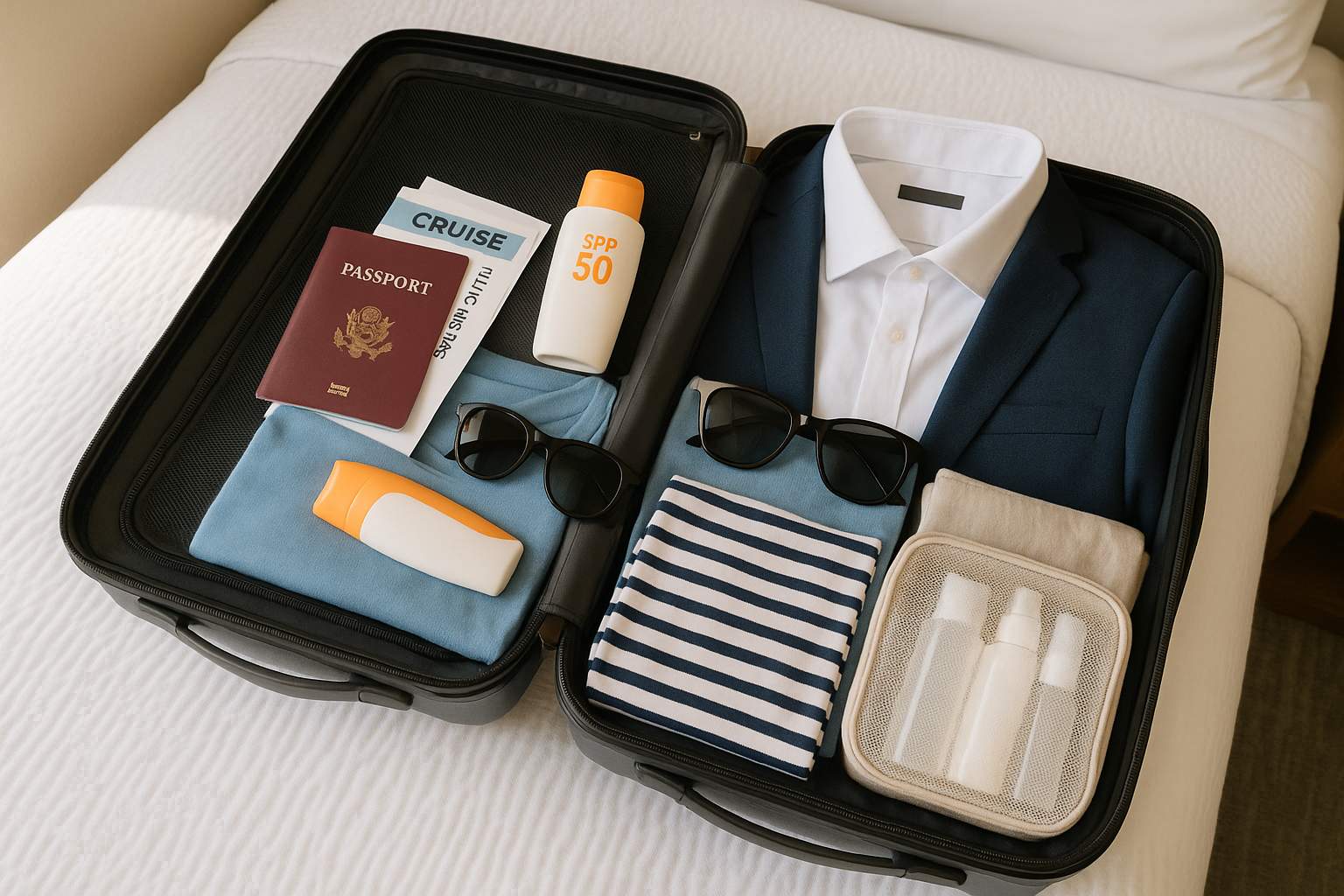
Packing for a cruise is unlike packing for any other vacation. You’re preparing for a floating resort that has everything from black-tie dinners to beach days, from casino nights to snorkeling adventures — all within the same trip. Get it right and your bags will feel purposeful. Get it wrong and you’ll spend your first port day hunting down a drugstore because you forgot sunscreen.
This guide covers everything you need to bring, what to leave at home, and the clever gear that experienced cruisers swear by.
Documents and Identification: Don’t Leave the Dock Without These
No document category is more important than this one. Missing or incorrect paperwork can get you turned away at the terminal — no exceptions, no matter how early you arrive.
Required for most cruises:
- Passport — The gold standard. Even on closed-loop cruises (those that start and end at the same US port) where technically a birth certificate plus government ID is accepted, a passport gives you a critical safety net. If you miss the ship in a foreign port, a passport lets you fly home. A birth certificate doesn’t.
- Government-issued photo ID — Driver’s license or state ID. Even with a passport, you may need this.
- Cruise boarding pass / e-ticket — Print it. Ship Wi-Fi is not the time to discover your phone battery is dead.
- SetSail Pass or equivalent — Most cruise lines have you complete check-in online and generate a check-in document. This is separate from your ticket.
- Visas — Required for certain destinations (Cuba, some Asia itineraries). Research well in advance.
- Travel insurance documents — Policy number, emergency contact, provider phone number. Keep a physical copy.
- Credit card on file — You’ll register one at check-in for your onboard account. Know which card you want to use.
- Health documents — Some itineraries still require vaccination records or health attestations. Check your cruise line’s requirements before departure day.
Store your passport and ID in your carry-on bag, never in checked luggage. Checked bags can be delayed by hours on embarkation day.
Clothing: Packing for Every Occasion
Cruise wardrobes need to span more territory than almost any other trip. Think in categories: sea days, formal nights, shore excursions, casual dining, and pool time.
Sea Day Casual
- Shorts, t-shirts, and sundresses for pool decks and buffets
- A light cardigan or layer — ship interiors are often aggressively air-conditioned
- Swimsuits (pack 2–3 so one is always dry)
- Cover-ups for walking between pool and restaurant
- Comfortable walking sandals
Formal Nights
Most cruise lines have 1–2 formal or “elegant” nights per week at sea. Royal Caribbean, Celebrity, Princess, and Holland America tend to take these more seriously. Carnival and Norwegian are more relaxed.
- Men: Dark suit or sport coat with dress pants; tie optional on most lines; tuxedos are no longer required anywhere
- Women: Cocktail dress, formal gown, or dressy separates
- Dress shoes — these take up space but formal night photos are often cherished mementos
Shore Excursion Clothing
- Comfortable closed-toe walking shoes for cultural sites (many require them)
- Water shoes for beach/snorkel excursions
- Light, breathable pants or shorts that dry quickly
- A daypack or small backpack for excursions
- Rain poncho — compact, lightweight, and invaluable in tropical ports
General Tips
Pack roughly one outfit per day for casual wear, fewer for formal. A 7-night cruise doesn’t mean 7 formal outfits — you’ll repeat casual clothes. Most ships have laundry services (paid) if you want to pack lighter.
Toiletries: What the Ship Provides vs. What to Bring
What Most Ships Provide (Free)
- Shampoo and conditioner (in-room dispensers or small bottles)
- Body wash or bar soap
- Lotion (sometimes)
- Hair dryer (almost universally provided now)
- Basic towels and washcloths
What You Should Still Bring
The ship’s toiletries are functional but rarely exceptional. Bring your own if you have preferences:
- Sunscreen — This is the most important item. Onboard sunscreen is expensive. Bring SPF 30–50, reef-safe formula if you’re visiting marine protected areas.
- After-sun lotion or aloe vera — You will get more sun on a cruise than you plan for.
- Your preferred shampoo and conditioner — Ship dispensers vary wildly in quality.
- Razors and shaving cream — Not provided.
- Toothbrush, toothpaste, floss — Never provided.
- Deodorant — Never provided.
- Feminine hygiene products — Available onboard but at significant markup.
- Prescription medications — Non-negotiable; bring more than you need.
- Motion sickness remedies — Sea-Bands, Dramamine, or your preferred option. The pharmacy at sea charges premium prices.
- Antacids, pain relievers, cold medicine — Again, available onboard but expensive.
- Small first aid kit — Band-aids, antibiotic ointment, blister pads (new shoes on formal night are a classic mistake).
Electronics: What to Bring and How to Power It
Cruise cabin outlets are notoriously scarce. Most cabins have 1–2 outlets of varying types (US and European), sometimes a USB port, and rarely more than that.
Essential Electronics
- Smartphone — Your boarding pass, cruise app, port maps, and everything else
- Camera — Ports and sea days deserve better than a phone camera if photography matters to you
- E-reader or tablet — Sea days and pool time are perfect for reading
- Laptop — Optional; ship Wi-Fi is slow and expensive, but useful if you need to work
Power and Adapters
- Non-surge power strip — This is the single most useful item experienced cruisers bring. Get one explicitly designed for cruise ships (no surge protector — those are prohibited). It turns one outlet into four.
- USB charging hub — Multi-port USB charger for phones, earbuds, and tablets
- Universal travel adapter — Helpful on international embarkation ports or European itineraries
- Portable power bank — Useful for long port days when you’re away from your cabin all day
Note: Surge-protected power strips, extension cords, and multi-outlet adapters with surge protection are explicitly banned by most cruise lines as fire hazards. Bring a plain power strip.
Clever Cruise-Specific Gear
Experienced cruisers have developed a short list of items that seem niche but genuinely improve the experience:
Over-the-Door Shoe Organizer
Cruise cabins are small and storage is limited. An over-the-door shoe organizer hung on the bathroom door becomes a command center for sunscreen, toiletries, medications, sunglasses, and chargers. It keeps countertops clear and everything accessible.
Magnetic Hooks and Clips
Cruise ship cabin walls are steel. Magnetic hooks (rated 10+ lbs) stick instantly and hold towels, lanyards, bags, and hats without damaging the walls. Bring 4–6.
Lanyards for Ship Cards
Your cruise card (or medallion, or wristband, depending on the line) is your room key, your payment method, and your boarding pass. Wearing it on a lanyard means you never lose it. Many cruisers buy lanyards designed specifically to hold the card format their line uses.
Collapsible Daypack
A lightweight packable daypack lives in your checked bag and comes out for port days. It holds water, sunscreen, snacks, your camera, and a cover-up. Don’t rely on flimsy tote bags for full excursion days.
Dry Bag
If you’re doing water-based excursions — snorkeling, kayaking, beach days — a dry bag protects your phone and valuables. A 10-liter dry bag is the right size for port days.
Reusable Water Bottle
Staying hydrated on a cruise ship is genuinely important. Water is free (from dispensers and at meals) but not always convenient. A refillable bottle saves money and keeps you from wilting in Caribbean heat on shore.
Medications: A Critical Category
Bring more medication than you think you need, plus extra in case of delays. Pack medications in your carry-on, never in checked luggage.
- All prescription medications with original pharmacy labels
- Over-the-counter medications you rely on (the ship’s pharmacy charges 3–5x retail)
- Motion sickness medication (start taking it the day before if using pill form)
- Antidiarrheal medication (norovirus is a real risk on cruise ships; be prepared)
- Sleep aids if you use them (time zone changes and cabin noise affect sleep)
- Allergy medication
- Epipen or emergency medications with a doctor’s note if applicable
If you have a medical condition, bring a brief medical summary in writing in case you need to visit the ship’s medical center.
What NOT to Bring: Prohibited Items
Cruise lines have security screening equivalent to airport-level checks. These items will be confiscated:
- Irons and steamers — Fire hazard; the ship has ironing rooms or laundry pressing services
- Surge-protected power strips or extension cords — Bring a non-surge plain strip only
- Candles or incense — Open flame, strictly prohibited
- Alcohol — Most lines prohibit bringing your own. Some allow one bottle of wine per adult at embarkation (check your specific line’s policy).
- Illegal drugs — Obviously
- Weapons — Including certain pocket knives; check restrictions
- Drones — Banned on virtually all cruise lines
- Heating coils or immersion heaters — Fire hazard
Your Embarkation Day Carry-On Strategy
Your checked luggage can take 2–6 hours to arrive at your cabin after boarding. You’ll be on the ship, eating, exploring, and heading to the pool — without your bags. Pack a carry-on with everything you need for that half-day:
- Documents (passport, boarding pass, cruise card)
- Medications
- Phone charger and power bank
- Swimsuit and cover-up (so you can hit the pool immediately)
- Change of clothes
- Sunscreen
- Snacks if you’re picky about embarkation day lunch options
- Camera
Dress for the embarkation photo opportunity. Many ports have professional photographers at the gangway — you might as well look ready.
Packing Light vs. Packing Everything
The eternal cruise packing dilemma: pack light and risk missing something, or pack heavy and drag enormous bags through airports and terminals.
For a 7-night Caribbean cruise, most experienced travelers manage comfortably with:
- One checked bag (under 50 lbs)
- One carry-on roller bag
- One personal item (daypack)
For a 14-night or longer cruise, or one that spans multiple climate zones, a second checked bag may genuinely be necessary — particularly if the itinerary includes formal nights, cold-weather ports, and beach days.
Whatever you pack, label every bag with your name, phone number, and cabin number before embarkation day. Baggage handling at busy ports like Miami and Fort Lauderdale moves thousands of bags. Make yours identifiable.
Cruising rewards preparation. A well-packed bag means you spend embarkation day relaxing on the Lido deck instead of hunting down a drugstore at your first port. Put in the planning, and every day of the voyage takes care of itself.