
How to Choose the Right Cruise Cabin: Interior vs Oceanview vs Balcony vs Suite
A complete guide to cruise cabin categories — comparing interior, oceanview, balcony, and suite options with pros, cons, pricing, and location advice.
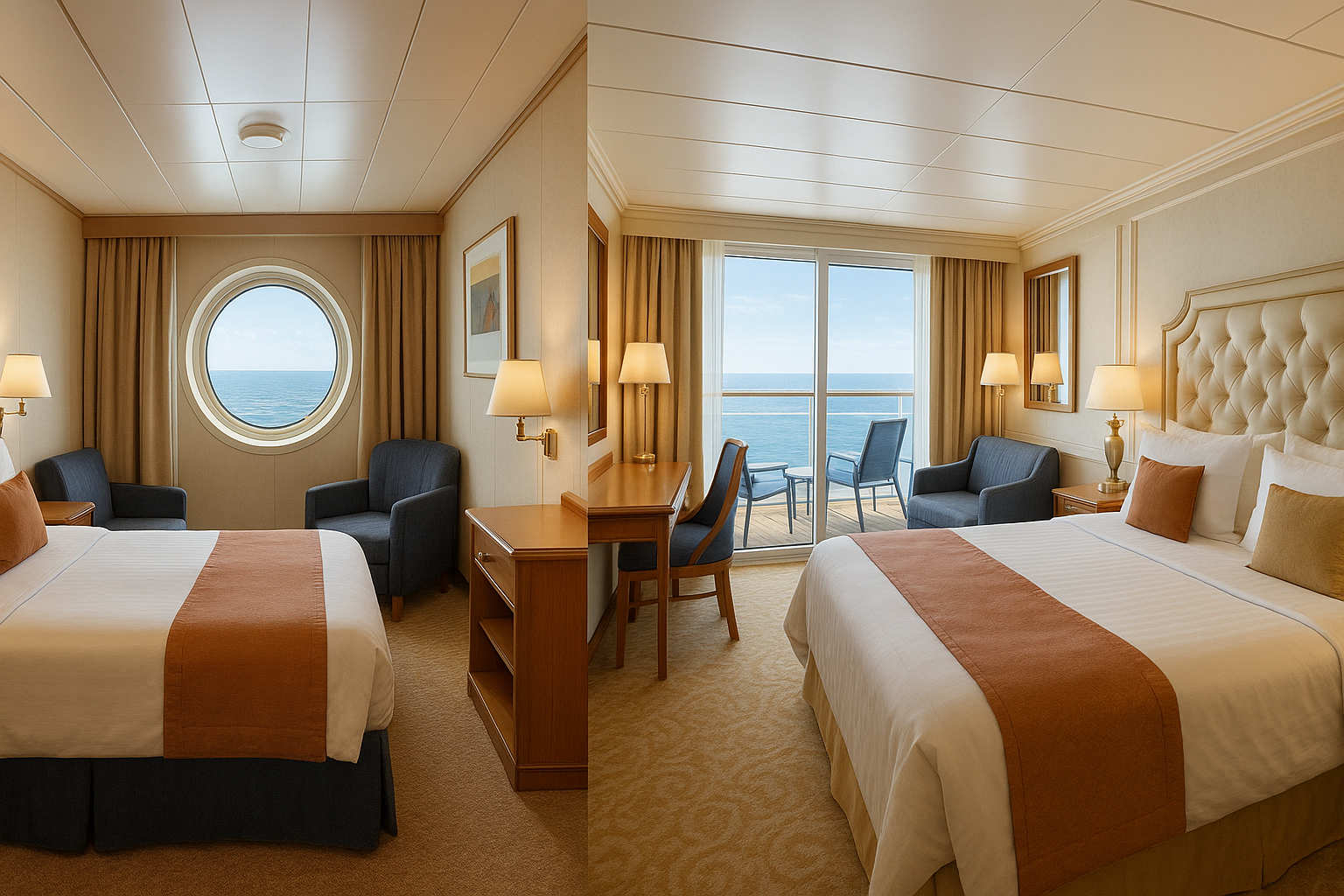
The cabin you choose will shape your entire cruise experience — how well you sleep, how much private outdoor time you have, how much money you spend, and whether you feel like you’re on a budget trip or a luxury escape. Cruise lines offer four main cabin categories, each with a dramatically different experience and price point. Here’s how to choose the one that’s right for you.
The Four Main Cabin Categories
Interior Cabins
Interior cabins have no window. That’s the trade-off for paying the lowest price on the ship. You get a fully enclosed room with no natural light or view, which sounds like a deal-breaker until you realize that many experienced cruisers book interior cabins deliberately.
Pros: The lowest price on the ship, often 30-50% less than a balcony. The darkness makes for excellent sleep — you’ll never wake up at 6 AM because the Caribbean sun is pouring through curtains. Interior cabins on modern ships are surprisingly well-designed, with good storage, comfortable beds, and full bathrooms.
Cons: No natural light, no way to check the weather or watch the ship leaving port, and a slight claustrophobic feel for some travelers. The room size is the same as other categories on most ships — you’re paying for the view, not the square footage.
Best for: Budget-focused travelers, cruise veterans who spend most of their time outside the cabin, night-shift workers whose bodies are already calibrated to sleeping in the dark, and anyone doing a short 3-4 night cruise where room time is minimal.
Price range: Typically $75-$150 per person per night on mainstream lines, depending on ship and itinerary.
Oceanview Cabins
An oceanview cabin is an interior cabin with a porthole or fixed window. You get natural light and a view of the sea, but the window doesn’t open and you have no outdoor space.
Pros: Natural light makes a meaningful quality-of-life difference, especially on longer sailings. You can watch sunrises, see what the weather looks like before getting dressed, and feel more connected to the ocean experience. Priced in the middle ground between interior and balcony.
Cons: The views on oceanview cabins can be partially obstructed — check the deck plans carefully. Some oceanview cabins on older ships have portholes so small they barely qualify as windows. You still have no outdoor space.
Best for: Travelers who want natural light but don’t plan to spend much time in the cabin. Alaska cruisers who want to watch for wildlife and scenery from their room. Anyone who finds interiors too claustrophobic.
Price range: Typically $90-$175 per person per night, a modest premium over interior.
Balcony Cabins
A balcony cabin is the most popular category for a reason: you get a private outdoor space with ocean views, fresh air, and the ability to sit outside in your pajamas watching the ship leave port or dock at a new destination. This is the sweet spot for most cruisers.
Pros: The private balcony is genuinely transformative. Morning coffee with ocean views, reading while listening to the sea, watching a port approach from complete privacy — these experiences define cruising for many people. Balcony cabins also feel larger because the sliding door brings the outside in, and they’re well-lit.
Cons: A meaningful price premium over interior and oceanview. On some ships, balconies are semi-private — the dividers between adjacent balconies can be flimsy and neighbors are within earshot. Balcony cabins on lower decks face lifeboats on many ships, blocking the view entirely. Location selection matters more here than in any other category.
Best for: First-time cruisers who want the full experience, anyone on a 7-night or longer sailing, Alaska itineraries (glacier and wildlife viewing from your private balcony is extraordinary), and couples who value morning-to-night private outdoor space.
Price range: Typically $130-$280 per person per night, sometimes doubling interior rates on premium ships.
Suites
Suites are an entirely different product. The best suites on modern ships are 1,000+ square feet with separate bedrooms and living areas, wrap-around balconies, butler service, exclusive lounge access with complimentary drinks, priority boarding and disembarkation, and dining options unavailable to the rest of the ship. Even entry-level “mini-suites” offer meaningfully more space than standard cabins.
Pros: The space, the service, and the exclusivity. Suite guests on lines like MSC, Norwegian, and Celebrity access ship-within-a-ship concepts (The Haven, The Retreat) with private pools, restaurants, and concierge service. Priority everything reduces lines. Butler service means someone unpacks for you, handles reservations, and delivers room service on china.
Cons: The cost. A full suite on a 7-night Caribbean sailing can run $600-$2,000+ per person per night — five to ten times an interior cabin. That money could fund multiple standard cruises.
Best for: Special occasions (honeymoons, anniversaries, milestone birthdays), anyone who wants the absolute best version of the cruise experience, and travelers who find the ship-within-a-ship concept appealing. Worth pricing out on repositioning cruises or shoulder-season sailings where suites discount aggressively.
Price range: Entry-level mini-suites from $250-$400/person/night; full suites from $500-$2,000+.
Location Matters as Much as Category
The cabin number matters as much as the category. Here’s what to know about position on the ship:
Forward, Midship, or Aft?
Midship cabins are the most stable ride. The ship pivots around a midpoint, so midship rooms feel the least motion. If you’re prone to seasickness, book midship.
Forward cabins are at the front of the ship. They’re often quieter (fewer neighbors coming and going), and forward-facing balconies have dramatic bow views. The trade-off: more motion in rough seas and some mechanical noise from the anchor on lower forward decks.
Aft cabins are at the back of the ship and among the most coveted. Aft balconies face the ship’s wake, are typically wider than side balconies, and offer beautiful views of the ocean receding behind you. The ship’s engine vibration can be felt on lower aft decks, but upper aft decks are spectacular. Engine noise at low throttle can also be a factor in port.
Deck Selection
Higher decks are more expensive and give you better views from balconies. They’re also farther from the pool area and dining, which can mean a lot of elevator riding.
Lower decks mean closer to tenders and easier gangway access in port, but views are more obstructed. Lower decks are also closer to the waterline and feel more stable.
Mid-ship, mid-deck is the consistently safe choice for comfort.
What to Watch Out For
Avoid cabins directly below the pool deck (deck chairs dragging at 6 AM), above the theater (late-night shows create vibration), next to the elevator banks (doors and conversations), and directly below or beside laundry facilities. Cruise ship deck plans are publicly available — always review them before confirming your cabin number.
On balcony cabins, look up your specific cabin number on sites like Cruise Critic’s cabin review database to see whether other cruisers have reported obstructions, noise, or smells.
Guarantee Cabins: The Gamble Worth Taking (Sometimes)
A “guarantee cabin” means you book a category — say, an interior or balcony — without selecting a specific room. The cruise line assigns you a cabin closer to sailing, sometimes upgrading you to a higher category than you paid for.
The upside: You pay the lowest price in the category, and upgrades happen regularly. Some cruisers book guarantee cabins specifically hoping to get bumped up.
The downside: You might get assigned the worst cabin in that category — the one with the obstructed balcony view, the room next to the laundry, the forward cabin over the anchor. You lose control of the outcome.
Guarantee cabins make sense when you genuinely don’t care about location, when you’re an experienced cruiser comfortable with whatever you get, or when you’re booking last-minute and good selection is already gone anyway.
Connecting Cabins for Families
Families traveling with children should specifically search for connecting or adjoining cabin options. Connecting cabins share an interior door between two adjacent rooms — perfect for parents and kids who want proximity without sharing a single room. Not all adjacent cabins connect, so filter for this specifically when booking.
Cruise lines like Disney, Norwegian, and Royal Caribbean have configurations designed specifically for families: family suites, multi-bedroom villa arrangements, and adjacent cabin clusters. These sell out months before sailing on popular family itineraries.
When to Splurge on a Suite
Splurging on a suite makes the most financial sense in a few specific scenarios:
Norwegian Cruise Line’s The Haven is arguably the best value in cruise suites. Haven guests have a private restaurant, private pool deck, dedicated concierge and butler service, and priority access to everything — effectively a luxury boutique hotel experience within a mega-ship. Booked far in advance, Haven suites can be competitive with two premium balcony cabins.
MSC’s Yacht Club operates on a similar model — an exclusive ship-within-a-ship with private dining, private pool, and white-glove service starting the moment you arrive at the terminal.
For honeymoons and anniversaries, the suite is worth pricing seriously. The difference between a balcony cabin and a suite on a special occasion sailing is a difference that lasts in memory long after the credit card statement is forgotten.
Repositioning cruises are where suite bargains live. Lines dramatically discount suites on transatlantic or transpacific repositioning voyages that don’t have the same leisure demand as Caribbean or Mediterranean itineraries.
Cabin Size Expectations by Cruise Line
Cabin sizes vary meaningfully across cruise lines. Here’s a general guide for standard balcony cabins:
- Carnival: 185-225 sq ft interior, balconies typically 35-55 sq ft
- Royal Caribbean: 150-180 sq ft interior, balconies 35-50 sq ft (newer Oasis/Icon class ships are larger)
- Norwegian: 150-170 sq ft interior, balconies 30-40 sq ft on standard cabins; Haven rooms dramatically larger
- Celebrity: 175-200 sq ft, above-average storage and finishes for the mainstream category
- Princess: 185-215 sq ft, known for well-designed storage
- Disney: 204-241 sq ft, notably larger than industry average and designed for families
- Viking: 270 sq ft standard veranda staterooms — one of the largest standard cabins in the industry
- Oceania/Regent: 200-307 sq ft with premium finishes; suites start at 400+ sq ft
The bottom line: for a 3-4 night cruise or a budget-focused sailing, an interior cabin is a perfectly sensible choice. For a 7-night or longer sailing, the balcony premium is almost always worth it. And for a once-in-a-while special occasion, pricing out the suite category might surprise you with what’s available.